
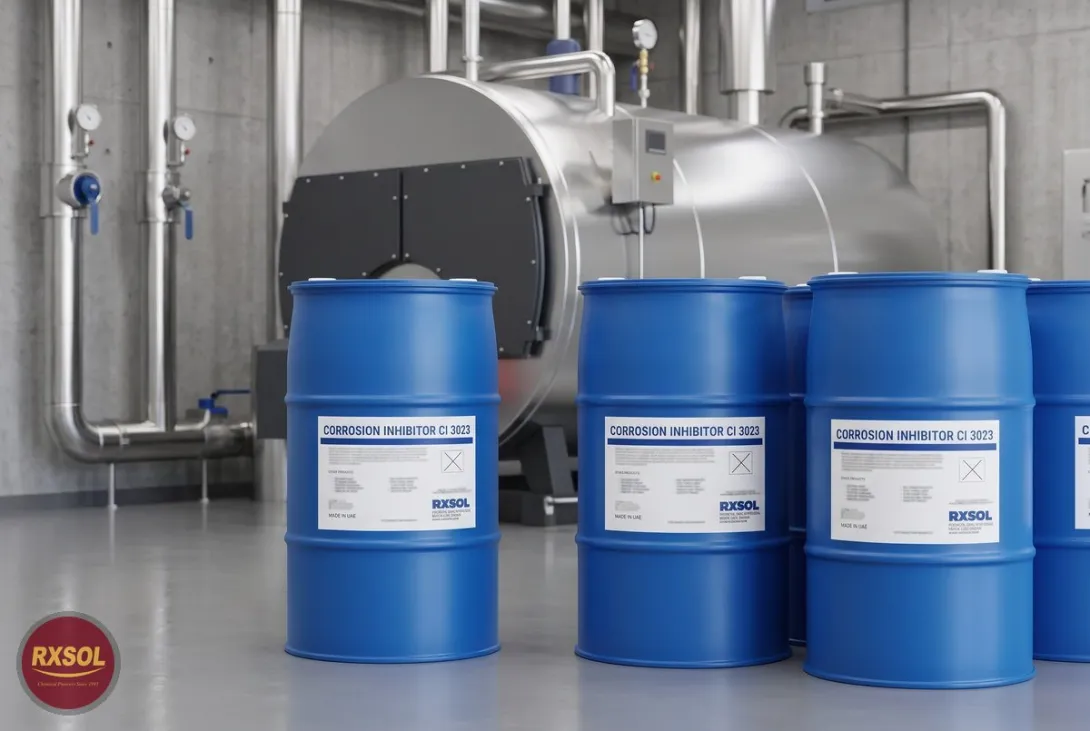
Amine is a chemistry and boiler inhibitor is a service, so the two overlap without being interchangeable. CI 3023 is a pipeline film-forming inhibitor, and its documentation does not cover boilers or steam condensate.
TL;DR
- An amine corrosion inhibitor uses amine chemistry. Neutralising amines raise condensate pH and filming amines put a barrier on the metal.
- A boiler programme also has to control oxygen pitting and deposits. Neutralising amines do not remove dissolved oxygen.
- CI 3023 is listed as a film-forming inhibitor for oil and gas production lines and pipelines, not for boilers.
- Published CI 3023 starting dose: 6-12 g/m³ of transported fluid, to be validated in the field. Check our TDS for the exact figure.
- Worked example: 10 g/m³ at 100 m³/h comes to 1 kg/h of product. This is arithmetic only, not a dose recommendation.
An amine corrosion inhibitor is any inhibitor that uses amine chemistry to slow metal loss. The term covers two different tools: neutralising amines that raise condensate pH, and filming amines that lay a protective barrier on the metal. A boiler inhibitor is named for where it is used, not what it is made of. A full boiler programme also has to deal with oxygen pitting and deposits, and no amine handles those on its own.
We supply Corrosion Inhibitor CI 3023 for the oilfield side of this split. The manufacturer lists it as a film-forming corrosion inhibitor for oil and gas production and pipeline transport. Its published documentation does not establish it as a boiler-water or steam-condensate treatment, so buy it as a pipeline product.
Amine corrosion inhibitor vs boiler inhibitor: the comparison
The two labels overlap because "amine" names the chemistry and "boiler inhibitor" names the job. The table sets the four product types you are likely to be quoted side by side.
| Type | Where it works | How it protects | Typical figure for this class | Deals with dissolved oxygen? | How you check it works |
|---|---|---|---|---|---|
| Pipeline film-forming corrosion inhibitor (CI 3023 type) | Crude oil, produced fluid and gas pipelines, flowlines and trunklines | Adsorbs onto the steel and forms a film between the metal and the corrosive fluid | 10-50 ppm continuous treatment in surface facilities and trunklines (class benchmark) | No | Laboratory test before trial, then corrosion coupons or probes |
| Neutralising condensate amine | Steam and condensate return lines | Neutralises carbonic acid from dissolved carbon dioxide and raises condensate pH | Example condensate pH of 8.8-9.2 for mixed copper and iron metallurgy | No | Condensate pH, iron and copper at near and remote sample points |
| Filming condensate amine | Steam and condensate lines | Forms a surface barrier against corrosive condensate | 0.7-1.0 ppm filming amine (octadecylamine example) | No | Corrosion coupons, iron analysis and corrosion-rate monitoring |
| Internal boiler treatment programme | Boiler water and feedwater | Several functions: general corrosion, oxygen pitting, condensate corrosion and deposit control | Set from your makeup-water analysis and boiler pressure | Only with deaeration or a treatment designed to react with oxygen | Feedwater and boiler-water testing |
Pick by service first. A pipeline needs a film-former suited to the produced fluid, a condensate network needs a steam-compatible amine, and a boiler needs a full programme with oxygen control.
Neutralizing vs filming amines in steam and condensate systems
Neutralising (neutralizing) amines fight carbonic acid corrosion by raising condensate pH. Filming amines leave the pH alone and coat the metal instead.
Neutralising amines
Carbon dioxide released in the boiler dissolves in the condensate as carbonic acid, and neutralising amines counter that acid. The handbook amines need 2.0-2.6 ppm of active neutralising amine per ppm of carbon dioxide. That is an active-amine ratio, not the feed rate of a finished product.
The dose depends on acid loading, on how the amine splits between steam and water, and on how much returns in the condensate. This steam-water split, often given as the amine distribution ratio, decides which part of the network an amine protects. The receiver can show acceptable pH while remote lines run unprotected, so take samples at the far end of the system as well as at the receiver.
Neutralising action is not oxygen scavenging. If air leaks in or deaeration is poor, oxygen keeps corroding the lines whatever the condensate pH reads.
Filming amines
Filming amines protect by forming a barrier between the metal and the condensate. Feed usually follows steam throughput and the requirements of the specific blend.
Start filming treatment slowly in a system that has been poorly treated before. Too much at the start can lift old corrosion deposits that then block traps and condensate equipment. Film-forming products for industrial steam generators need guidance for that specific use, and putting the wrong film-former into a water-steam cycle raises the risk of corrosion damage.
Where CI 3023 fits, and what its documentation confirms
CI 3023 is a pipeline and production-line film-former. Nothing published for it supports using it as a boiler corrosion inhibitor or condensate amine.
Use this evidence checklist before you write CI 3023 into a specification.
- Published: film-forming corrosion inhibitor for oil and gas production and pipeline transport.
- Published: a pipeline starting dose of 6-12 g/m³ of transported fluid (the manufacturer also labels this ppm), to be validated in the field.
- Published: two part numbers. RXSOL-34-8165-211 sits in the rigs category and RXSOL-81-8165-211 in the drilling fluids category, and the technical table refers to the second code.
- Not published: chemical composition (proprietary), whether the active is amine-based, steam volatility, flash point, and suitability for boilers or condensate.
- To confirm on your fluid: solubility or dispersibility in the actual process fluid.
When you order, ask for the current TDS and SDS, and ask us to confirm in writing that both part numbers refer to the formulation you are buying.
| Item | CI 3023 |
|---|---|
| Part number | RXSOL-34-8165-211 / RXSOL-81-8165-211 |
| Product type | Film-forming corrosion inhibitor |
| Application | Internal corrosion control in oil and gas production lines and pipeline transport |
| Starting dosage | 6-12 g/m³ of transported fluid, typical published starting range for field validation; refer to our TDS for the exact figure |
| Composition | Proprietary |
| Boiler or condensate use | Not established by current documentation |
| TDS and MSDS | On request |
How to work out pipeline corrosion inhibitor feed for CI 3023
Multiply the dose in g/m³ by your flow in m³/h to get grams of product per hour. The worked example below is arithmetic only, not a dose recommendation for your line.
- Take an assumed dose of 10 g/m³, which sits inside the published 6-12 g/m³ starting range.
- Take an assumed flow of 100 m³/h of transported fluid.
- 10 g/m³ x 100 m³/h = 1,000 g/h, which is 1 kg/h of product, or 24 kg per day at constant flow.
- To set a pump in L/h, divide kg/h by the product density from the TDS. Do not guess the density.
- Confirm the result with coupons or probes after start-up, and adjust within the range the TDS gives.
For comparison, typical continuous treatment for oilfield surface facilities, flowlines and trunklines is 10-50 ppm. One published filming-amine pipeline example ran at about 70 °C, and that is a single operating example, not a temperature limit. Never carry these pipeline figures over to boiler service.
How do you select an inhibitor for CO2 or H2S corrosion?
Start from your operating data, because the gas, water and temperature in your line decide which inhibitor will hold a film. Test in the laboratory before any field trial.
For a pipeline or flowline, record acid gases (CO2 and H2S), temperature, pressure, water content and dissolved salts. If your produced water is saline, give the salinity figure, since dissolved salts change how corrosive the water is. Hydrogen sulphide can drive hydrogen into steel and cause cracking, so sour service needs an assessment that covers cracking as well as general metal loss.
The inhibitor itself needs checking for how it splits between water and oil, solubility, emulsion and foam tendency, thermal stability, toxicity, and compatibility with the other additives and materials in the system. Rotating-cage testing is a common laboratory method before a trial.
For a boiler or condensate system the inputs are different: makeup-water analysis, boiler pressure, how much condensate returns, the metals in the network (steel, copper or both), and sample points near the boiler and at the far end of the lines.
Handling CI 3023 safely
Read the SDS before handling, and wear suitable gloves and eye protection. Work with good ventilation and store drums away from heat, ignition sources and incompatible materials.
The manufacturer's public safety text warns of flammable vapours and of skin, eye and inhalation hazards, but the technical page leaves composition and flash point unconfirmed. Check every precaution against the SDS for the batch you receive.
Where to buy CI 3023 in Muscat and across Oman
Muscat Chemical (Muscat & Barka for Business Trading) supplies CI 3023 from Barka Industrial Area, Sultanate of Oman. We deliver from our Barka warehouse to plants and sites in Muscat, and to Sohar, Duqm and Salalah on request.
For loads to Sohar port and North Batinah sites, the same part number is listed on our Sohar CI 3023 page. Buyers who order through our national catalogue can use CI 3023 on omanchem.com. The rigs-category listing is CI 3023, RXSOL-34-8165-211. For condensate or boiler chemicals, browse our full product range.
What to send with your quote request
- Service: pipeline, flowline, production line, condensate network or boiler.
- Fluid data: water cut, dissolved salts, CO2 and H2S levels, temperature, pressure and flow in m³/h.
- Metallurgy of the lines and equipment.
- Other chemicals dosed into the same stream, so we can check compatibility.
- The monitoring you already run: coupons, probes, iron counts or pH points.
- Documents you need: current TDS, SDS, written confirmation of the part number, and any laboratory test requirement.
- Quantity and delivery point in Oman.
Phone +968 77333599 or email muscatchem@gmail.com. To request a quote, send your line data on WhatsApp +968 77333599 or use our quote request form.
Need CORROSION INHIBITOR CI 3023? Ask us for a quote, the TDS or the MSDS. Delivery across Oman from our Barka warehouse.
Frequently asked questions
What is an amine corrosion inhibitor?
It is a corrosion inhibitor based on amine chemistry. Neutralising amines raise condensate pH by countering carbonic acid, and filming amines form a barrier on the metal surface. Pipeline film-forming inhibitors work in a similar way in oil and gas lines.
Do neutralizing amines remove dissolved oxygen?
No. Neutralising amines raise pH, but they do not scavenge oxygen. Dissolved oxygen needs deaeration or a treatment that reacts with oxygen, and without one, oxygen corrosion can carry on at acceptable pH.
Can CI 3023 replace a boiler corrosion inhibitor?
No. CI 3023 is documented as a film-forming inhibitor for oil and gas production and pipeline transport. Its published data does not establish amine composition, steam volatility or suitability for boiler water or steam condensate.
Why can condensate corrosion continue when receiver pH looks acceptable?
An amine splits between steam and water, so it may protect the lines near the receiver while far lines stay unprotected. Oxygen and other contaminants can also keep corrosion going at acceptable pH, so sample at remote points as well.
How is corrosion inhibitor dosage determined?
For pipelines, the dose is based on transported-fluid flow. The published CI 3023 starting range is 6-12 g/m³, confirmed with laboratory tests, coupons or probes. Condensate amine dosage depends on acid loading, distribution and recycling. Refer to our TDS for the exact figure.