Oxygen Scavenger
MSDS not yet available online for this product — email us at muscatchem @ gmail.com and we'll send you a copy.
This is most common oxygen treatment as a scavengers used to effectively remove dissolved OXYGEN from your feedwater. By the presence of dissolved oxygen in system, corrosion and pitting caused on metal surface. Removes dissolved oxygen, By acting as an oxygen scavenger.
Key facts
- Product
- Oxygen Scavenger
- Part No.
- RXSOL-44-6119-250
- Category
- Corrosion Inhibitor
- Supplier
- Muscat Chemical, Barka, South Al Batinah, Oman
- Delivery
- Muscat, Sohar, Salalah, Duqm, Nizwa, Sur, Barka and Gulf ports
- Documents
- MSDS and TDS on request
- Pricing
- Quote on request — contact us or WhatsApp +968 77333599
PHYSICAL AND CHEMICAL PROPERTIES
| Formula | Proprietary Blend |
| Physical appearance | Clear, Yellow coloured solution free From foreign particles. |
| Specific Gravity | 1.26 TO 1.3 |
| pH | 3.2- 4 |
| Description | Colorless liquid with strong smell |
| Standard Packing |
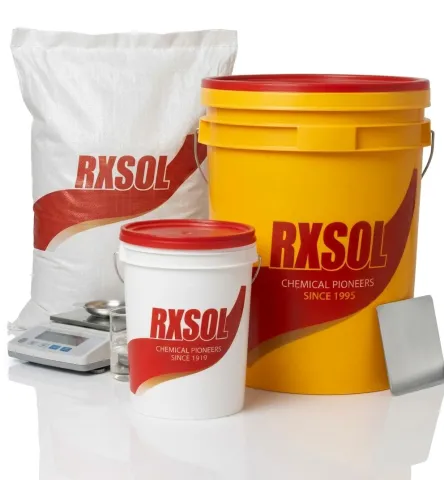
250 Kgs. HDPE Drum 1000 Liters Intermediate Bulk container (IBC) Special packaging requirements can be accommodated. |
Oxygen Treatment scavenger is a class of chemicals added to react and remove oxygen in water to protect against oxygen induced corrosion. The use of Sodium Bisulphate as a chemical deoxygenator is economical within certain limitations imposed by the dissolved oxygen content. Sodium Bisulphate is relied on as the sole means of oxygen removal. Generally, costs are balanced by removal of as much of the oxygen as feasible by mechanical means, e.g. deaerator and by using Sodium Bisulphate to react with the residual oxygen.
To prevent corrosion and pitting it is desirable to feed the Sodium Bisulphate. Oxygen scavengers capture the dissolved oxygen in a harmless chemical reaction that renders the oxygen unavailable for corrosive reactions.
Dosage
Theoretically, 7.88 pounds of RXSOL-44-6119-250 are required to remove one pound of oxygen. The efficiency of the oxygen removal is estimated at 75 per cent to allow for oxidation in contact with air, blowdown losses, etc. Therefore it is estimated that 10 pounds of RXSOL-44-6119-250 are required for each pound of oxygen removed (or 10 ppm RXSOL-40-5023-210 per 1 ppm dissolved oxygen.)
Industrial Usage
We are a leading manufacturer and exporter of oil fields chemicals.
We are offering the following chemicals used in oil extracting industries as an oxygen scavenger, in water treatment to remove dissolved oxygen and in manufacturing of caramels. We are committed to provide high-quality products and service to our customers.
Products:
Sodium Bisulphate - 65 %
Sodium Bisulphate solution - 65 %
Sodium Bisulphate solution - 40 %
Sodium Bisulphate solution - 75 %
Please feel free to keep in touch with us about any of your business-related inquiries / requirements.
Remarks
The most common oxygen scavengers in oilfield production are sodium bisulfite (SBS) and ammonium bisulfite (ABS). Ammonium bisulfite is more water soluble than sodium bisulfite and typically react with oxygen faster. However, ammonium in the ammonium bisulfite can promote bacteria growth.
Being a salt of a weak acid and a strong base, sodium bisulfite forms a significantly basic aqueous solution whereas ammonium bisulfite is only slightly basic at around pH 8. As a rule of thumb, 60ppm of 65wt% ammonium bisulfite is required to reduce the oxygen concentration in water from 9ppm to 50ppb.
The reaction of bisulfite with oxygen is typically faster at higher temperatures and can be facilitated by transition metal ion catalysts, e.g. Cobalt.
The most common applications of oxygen scavenger in oil and gas production are for seawater injection facilities, hydro-testing, and acid stimulation
It is used to arrest oxygen in sea water
It removes Entrapped Oxygen and thus reduces Corrosion
In Oil Drilling Chemicals
Supply Locations
Oxygen Scavenger supplier and exporter from Mumbai, Chennai, Kolkata, Visakhapatanm, Gandhidham, Fujairah, Sharjah, Dubai, Abudhabi, Gulf Middle East, Muscat Barka Sohar Oman, Nairobi Kenya Africa, Canada
Product FAQs
How much Oxygen Scavenger should be dosed into boiler feedwater?
Dose continuously into the feedwater storage section of the deaerator so the product has contact time before the boiler. As a starting point, hold a small measurable reserve at the economiser or boiler inlet and adjust to site conditions — make-up rate, deaerator performance and operating pressure all change the demand. Verify with routine dissolved-oxygen and scavenger-reserve tests and let our technical team review the results for your plant.
Is this Oxygen Scavenger safe for high-pressure boilers and food-grade steam?
The product is formulated for low, medium and high-pressure boilers and forms stable, non-volatile by-products. For food-grade or culinary-steam applications, confirm the specific grade with us first so we can supply a version approved for that duty along with its documentation.