A buyer's guide to bulk engine coolant for fleets and diesel generators in Oman. It covers which coolant type to choose, the right mix ratio and dilution water for hot conditions, site testing, and delivery from Barka.
If you run trucks, buses, earthmoving plant or diesel generators in Oman, you need a bulk antifreeze coolant supplier who can tell you which coolant to use, at what strength, and how to keep it working through a Muscat summer. We supply engine coolant from Barka Industrial Area, Sultanate of Oman. In Oman the coolant has to protect against boil-over, corrosion and cavitation far more than against frost. That makes the inhibitor package and the water you mix it with as important as the glycol.
Choosing a bulk antifreeze coolant supplier in Oman: heat, not frost
Antifreeze coolant is a glycol base, usually monoethylene glycol (MEG) or propylene glycol, plus a corrosion inhibitor package. The glycol gives freeze and boil protection, and the inhibitors protect the block, radiator, water pump and pipework.
Engines in Muscat, Sohar or Duqm never see frost, but summer shade temperatures above 45°C push every radiator hard. A typical 50/50 mix boils at about 106°C unpressurised and about 129°C under a 15 psi radiator cap. Glycol does not stop corrosion by itself. The inhibitors do that, and they deplete over time while the glycol stays stable, so a coolant can read correctly on a refractometer and still give your engine little corrosion protection.
If your engine needs no freeze protection, you have two choices: a glycol antifreeze coolant mixed to the engine maker's ratio, or an inhibitor concentrate added to treated water. If your engine manual calls for a glycol coolant, use one.
Coolant types and the standards to ask for
The inhibitor chemistry sets the service life and decides what the coolant can be mixed with.
- IAT (inorganic additive technology) uses silicates, phosphates and nitrites, with a typical life of about 2 years.
- OAT (organic acid technology) uses carboxylates such as sebacate and 2-ethylhexanoic acid, with a typical life of up to 5 years. Long-life OAT coolants are typically free of nitrites, amines, phosphates, borates and silicates.
- Hybrid HOAT or Si-OAT coolants blend organic acids with silicates.
- Heavy-duty diesel systems may also run a supplemental coolant additive (SCA). The SCA level has to be monitored and topped up as needed.
Do not mix IAT and OAT coolants, because the mixture can form sludge. In a mixed fleet of light vehicles, buses, trucks and plant, match each engine to its maker's specification and label your top-up containers by vehicle group.
When you buy in bulk, ask which standard the product meets. ASTM D3306 covers glycol-base engine coolant for automobile and light-duty service, as concentrate or 50% predilute. Heavy-duty engines are covered by ASTM D4985 and D6210, and some heavy-duty engine makers call for extended-life, nitrite-free, low-silicate coolant. With a first bulk order, ask for the SDS.
Concentrate, premix and our RXSOL-40-4004 engine coolant
Concentrate must be diluted with water before use, and adding it neat can damage the cooling system. Premixed coolant is typically 50/50 glycol and distilled water. Concentrate suits a workshop that has treated water and someone who checks each batch with a refractometer. Ready-to-use premix suits mixed fleets, remote camps and unmanned genset sites, because the ratio is fixed before the drum is opened. Across the trade, bulk coolant typically comes in 200-250 L drums and 1000 L IBC totes.
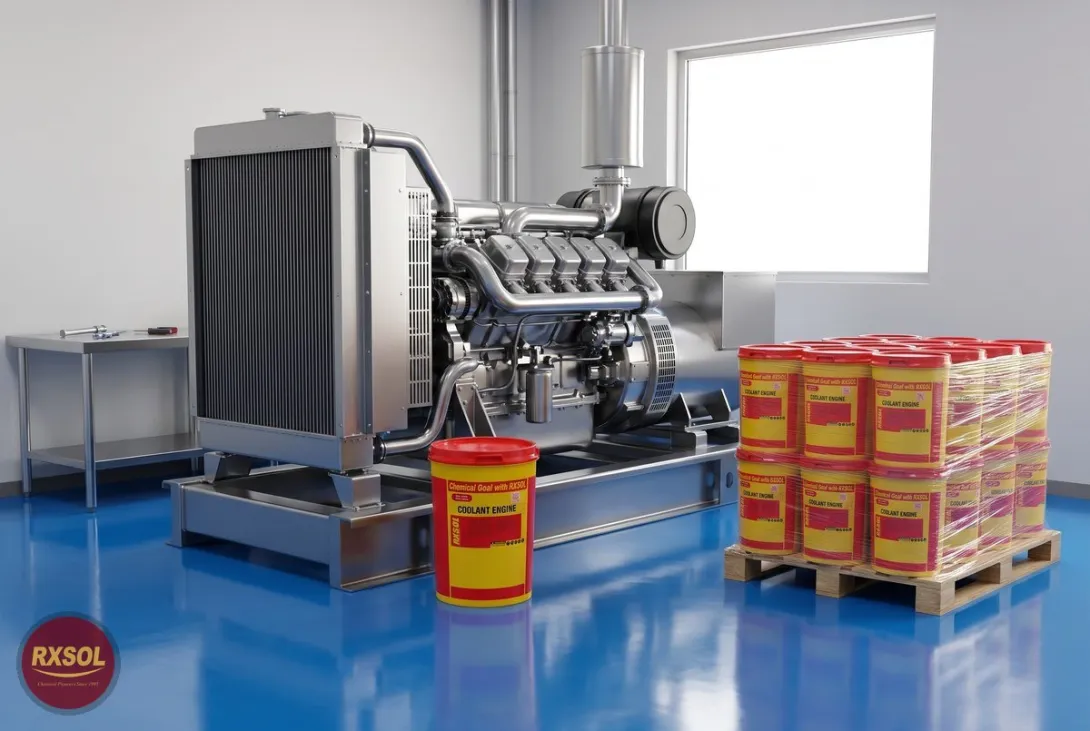
Our RXSOL-40-4004 coolant concentrate is an inhibitor concentrate added to the cooling water of internal combustion engines where the coolant does not need to be protected from freezing. At a concentration of 10% by volume it protects against cavitation and corrosion in the metals and alloys used in cooling systems, such as aluminium, ferrous and yellow metals. It is intended for heavy-duty engines such as those in trucks, ships and locomotives, and for diesel engine and generator cooling systems.
The blend contains 3 to 15% benzotriazole, which helps prevent cavitation corrosion in high-speed coolant pumps with aluminium housings and impellers. It is nitrite free, so it is also compatible with zinc-coated piping, and you can check the concentration on site with a refractometer. You will find it on our site as Radiator Coolant (RXSOL-40-4004-010) and as Coolant Engine in 20 litre packing (RXSOL-40-4004-020).
| Item | RXSOL-40-4004 engine coolant |
|---|---|
| Part numbers | RXSOL-40-4004-010; RXSOL-40-4004-020 (20 Ltr); RXSOL-40-4004-025 (25 Ltr) |
| Type | Inhibitor concentrate for engine cooling water, nitrite free |
| Application | Diesel engine and generator cooling systems; heavy-duty engines in trucks, ships and locomotives |
| Dosage | 10% by volume in treated water |
| Dilution water limits | Water hardness 0 - 100 ppm; chloride max 100 ppm; sulphate max 100 ppm |
| Physical data | Clear liquid; density 1.096 g/cm3; product pH neat 9.5; corrosive action: none |
| Composition (SDS) | Glycol 40-50%; contains 3 to 15% benzotriazole |
| Packing | 20 litre (RXSOL-40-4004-020); 25 litre (RXSOL-40-4004-025) |
| Concentration check | Refractometer |
Mix ratio and water quality for Oman's hot climate
For a glycol antifreeze coolant, diesel generator manuals typically specify 50% ethylene glycol with 50% clean, softened water. That gives freeze protection to about -34°F and overheat protection to about 265°F. The same manuals warn that less than 50% may not protect adequately and more than 50% can damage the engine or its components.
More glycol does not mean more cooling. At 50/50, heat transfer is already lower than with plain water. Above about 70% glycol the freeze point rises again, so 70% is the practical maximum. For Oman we advise a 50% mix unless your engine maker gives a different figure, in which case follow the manual. Our RXSOL-40-4004 concentrate is used differently: you dose it at 10% by volume.
Why not tap water
Dilute with distilled, deionised or demineralised water. Tap water adds minerals, chlorides and microbes that cause scale and corrosion, which makes it a poor dilution water.
The water for our concentrate should be clean but not too hard, within these limits: water hardness 0 - 100 ppm, chloride content max 100 ppm, sulphate content max 100 ppm. Sea water, a mixture of sea water and fresh water, salt water and industrial waste water are unsuitable. If your water does not meet the limits, treat it by adding softened, distilled or deionised water. If you use RO water from your own plant, test it against the same limits first.
Testing and maintenance for gensets and fleets
Standby generators can sit idle for weeks and then have to take full load in the hottest month of the year. Check them before the summer peak, not after the first overheat alarm.
- Keep the cooling air inlets and the radiator clean and unobstructed. In Oman, that means clearing dust and sand from the radiator fins on a set schedule.
- Never add coolant to a hot engine.
- Use a refractometer to check freeze and boil protection (glycol %). It does not show inhibitor depletion, so use test strips for pH and inhibitor level.
- An oil sheen in the coolant suggests head gasket or seal failure. Rust or sludge are warning signs.
- Even long-life coolant needs periodic checks of concentration and condition, especially in hard-working plant and commercial vehicles.
Top up when the level is low and the coolant is clean and in range. When you find rust, sludge or oil, drain the system, flush with distilled water, refill and bleed the air. Then recheck the level after the first heat cycle.
Storage, spills and disposal
Follow sections 7 and 8 of the product SDS for storage conditions and PPE. Pure ethylene glycol is classified Acute Tox. 4 (H302, harmful if swallowed) and STOT RE 2 (H373, may cause kidney damage through prolonged or repeated exposure if swallowed). Swallowing ethylene glycol coolant is dangerous to people and animals, and small volumes can be fatal to children, so keep coolant locked away at camp sites. Absorb spills with sand or absorbent and keep them out of drains. Used coolant is treated as hazardous waste and can be recycled by distillation. Dispose of contents and container at an approved waste disposal facility.
Where to buy bulk antifreeze coolant in Muscat and Oman
Muscat Chemical (Muscat & Barka for Business Trading) supplies engine coolant from Barka Industrial Area, Sultanate of Oman. Send us your engine makes, monthly volume and site location, and we will confirm the grade and pack size for your order.
If your fleet works out of the north, the same radiator coolant is also listed on our Sohar site. The radiator coolant is also listed on our Salalah site. For other workshop and water treatment chemicals, see our full product range. Call +968 77333599, email muscatchem@gmail.com, or message us on WhatsApp.
Frequently asked questions
Do I need antifreeze in Oman if it never freezes?
Your engine still needs a treated coolant, because in Oman it has to protect against boil-over, corrosion and cavitation. Use a glycol coolant where your engine manual specifies one. Where the coolant does not need freeze protection, use an inhibitor concentrate such as our RXSOL-40-4004.
What is the correct coolant to water ratio for hot climates?
Diesel generator manuals typically specify 50% ethylene glycol with 50% clean, softened water. Above about 70% glycol the freeze point rises again. Follow your engine maker's figure. Our RXSOL-40-4004 inhibitor concentrate is dosed at 10% by volume.
Can I use tap water to dilute coolant concentrate?
No. Tap water adds minerals, chlorides and microbes that cause scale and corrosion. Use water within hardness 0 - 100 ppm, chloride max 100 ppm and sulphate max 100 ppm. Sea water is unsuitable.
Can I mix OAT and IAT coolants?
Do not mix them, because the mixture can form sludge. Follow the engine manufacturer's specification.
Where can I buy antifreeze coolant in bulk in Oman?
Muscat Chemical supplies engine coolant from Barka Industrial Area, Sultanate of Oman. Call +968 77333599 for a quote.
To order, request a quote with your engine type, volume and site location, or send it on WhatsApp to +968 77333599.
Frequently asked questions
Do I need antifreeze in Oman if it never freezes?
Your engine still needs a treated coolant, because in Oman it has to protect against boil-over, corrosion and cavitation. Use a glycol coolant where your engine manual specifies one. Where the coolant does not need freeze protection, use an inhibitor concentrate such as our RXSOL-40-4004.
What is the correct coolant to water ratio for hot climates?
Diesel generator manuals typically specify 50% ethylene glycol with 50% clean, softened water. Above about 70% glycol the freeze point rises again. Follow your engine maker's figure. Our RXSOL-40-4004 inhibitor concentrate is dosed at 10% by volume.
Can I use tap water to dilute coolant concentrate?
No. Tap water adds minerals, chlorides and microbes that cause scale and corrosion. Use water within hardness 0 - 100 ppm, chloride max 100 ppm and sulphate max 100 ppm. Sea water is unsuitable.
Can I mix OAT and IAT coolants?
Do not mix them, because the mixture can form sludge. Follow the engine manufacturer's specification.
Where can I buy antifreeze coolant in bulk in Oman?
Muscat Chemical supplies engine coolant from Barka Industrial Area, Sultanate of Oman. Call +968 77333599 for a quote.