Which grade of demineralised water to use for batteries, boilers, labs and cooling systems, with our datasheet values, storage advice for Oman's heat and delivery from Barka to Muscat.
Batteries that lose capacity, boilers that scale and lab glassware that dries with spots all point to the same fix: demineralised water, which we supply to buyers in Muscat from Barka. Demineralised water, also sold as DM water, demin water, deionised water or DI water, is water from which mineral and salt ions such as calcium, magnesium, sodium, chloride, sulphate and nitrate have been removed. Our standard grade is specified at conductivity < 10.0 Micromohms/cm, with nil hardness and nil chloride. You use it neat, with no dilution, for battery top-up, boiler feed, laboratory rinsing, autoclaves, laser cutting and engine cooling systems.
What is demineralised water and how is it made?
Most DM water is produced by ion exchange. The feed water passes through a cation resin, where positive ions are swapped for H+, and then an anion resin, where negative ions are swapped for OH-. The resins are regenerated with acid and caustic. Larger plants often run reverse osmosis first and polish the water in a mixed bed deioniser, or use electrodeionisation.
Reverse osmosis alone can remove up to about 99.8% of salts. Dissolved solids in demineralised water can be as low as 1 mg/l and are always less than 10 mg/l. Some conductivity always remains: the theoretical best quality is about 18.2 MΩ·cm resistivity, or 0.055 µS/cm conductivity.
Tap water in Muscat is no substitute. Most of it comes from desalination, and desalinated water is remineralised before it enters the network, so its conductivity is much higher than DM water. It is fine for drinking and wrong for a battery or a boiler.
Which grade of DM water do you need?
Battery top-up water
Tap or tank water contains minerals and salts that can drastically shorten the life of a lead-acid battery, so top up only with demineralised or battery-grade water. The Indian standard IS 1069:2021 for lead-acid battery water sets pH 6.5 to 7.5 and a maximum conductivity of 0.5 µS/cm at 25°C, and IEC/EN 62877-2 covers water for preparing electrolyte and topping up vented lead-acid cells. Our standard grade is specified at < 10.0 Micromohms/cm. If your battery maker names one of these standards, compare its figure with our datasheet values before you order.
Boiler feed water
Boilers and steam raising plants, including high-pressure boilers, use DM water to keep hardness and scale off the tubes. Typical industrial DM plant output is about 1 to 10 µS/cm conductivity, and twin-bed systems give typical reactive silica of 10 to 30 ppb. Your boiler maker's limits for conductivity and silica decide whether delivered water suits your make-up duty.
Laboratory grade water and autoclaves
Labs use DM water as a solvent, for buffer preparation, for diluting solutions, for rinsing glassware and as autoclave feed, which extends the life of the chamber and steam generator. A typical supplied-grade specification for this kind of work is conductivity below about 1.5 µS/cm, pH about 5 to 8 and chloride below 1 mg/L. Conductivity can rise during storage, so check it before critical tests.
Cooling, laser and fire-mist systems
Car and aircraft cooling systems, gas-turbine engines and laser cutting all take DM water, because calcium in ordinary water causes build-up and corrosion. Its low conductivity is why it is used in water-mist extinguishers for electrical fires, and because it leaves no residue it gives a smear-free final rinse for vehicle and window washing.
How to top up a battery with demineralised water
No dosage or dilution applies. DM water is used neat as supplied, following the equipment manufacturer's guidelines. For a flooded lead-acid battery in a forklift, car, UPS room or ship, the routine is short.
- Wear eye protection and gloves, as the electrolyte is acid.
- Top up after charging, unless the battery manual says otherwise.
- Fill each cell to the level mark and no higher, so it does not overflow on charge.
- Pour from a clean, sealed plastic container, never from a metal can, a drinking bottle or a tank that has held other liquids.
- Discard any water that looks or smells contaminated.
Demineralised water specification
The table gives our datasheet values for part numbers RXSOL-20-2204-025, RXSOL-20-2204-210 and RXSOL-25-2204-005. Rows marked typical describe this product class in general.
| Item | Value |
|---|---|
| Part numbers | RXSOL-20-2204-025, RXSOL-20-2204-210, RXSOL-25-2204-005 |
| Application | Laboratory testing and autoclaves, automotive and aircraft engine cooling systems, lead-acid batteries, laser cutting, humidifiers, fine-mist fire-fighting equipment, final rinse for car and window washing |
| Dosage | None. Used neat as supplied, following the equipment manufacturer's guidelines |
| Conductivity | < 10.0 Micromohms/cm |
| TDS | 3-4 PPM |
| Hardness | Nil |
| Chloride | Nil |
| Total alkalinity | 5-6 PPM |
| Total matter, ppm Max | 100 (ASTM D5907) |
| pH | 6.5 - 8.5 (ASTM D1293) |
| Sodium + Potassium, ppm Max | 25 (ASTM D4191 & 4192) |
| Suspended particles | None larger than 100 microns |
| Shelf life | Typically 12 to 18 months from the batch date (typical for the class) |
| Hazard classification | Not classified as hazardous, not regulated for transport. CAS 7732-18-5, EC 231-791-2 |
| MSDS | On request |
Before you accept a delivery, measure conductivity at the gate with a handheld meter, keep the MSDS on file and check that every container arrives clean and sealed.
Storing DM water in Oman's heat
Demineralised water is aggressive to metals, even stainless steel, so it is usually transported and stored in plastic containers. Fixed storage tanks in plants are built from non-corrosive materials such as stainless steel or reinforced plastic. Never decant it into mild steel drums.
Keep containers tightly sealed and upright, in a cool, well-ventilated place away from direct sunlight. A summer yard in Barka or Rusayl is hard on any container, so store indoors or under shade. Once a container is open, the water absorbs carbon dioxide from the air and its conductivity rises, so reseal it straight after use. Any contaminated product must be discarded.
DM water is not for drinking or cooking. It can leach metals from pipes and tanks, and regular consumption of low-mineral water is linked to health risks, so label containers and taps for non-potable use.
Where demineralised water is used in Oman
In Muscat, typical buyers are laboratories, vehicle workshops, forklift fleets and maintenance teams with UPS battery rooms. Across Oman, demand also comes from power plants, refineries, cooling towers, pharmaceutical and cosmetics production, electronics and circuit-board rinsing, and food plant sanitising.
At Sohar, Duqm and Salalah ports, ship agents order DM water for ship batteries, engine cooling top-up and fire-mist systems. The same product is also listed by Sohar Chemical for Sohar port enquiries, and buyers in Dhofar can enquire through Salalah Chemical for Salalah port and Raysut.
Where to buy demineralised water in Muscat and Oman
Muscat Chemical (Muscat & Barka for Business Trading) supplies demineralised water from Barka Industrial Area, Sultanate of Oman. Call +968 77333599, message us on WhatsApp or email muscatchem@gmail.com.
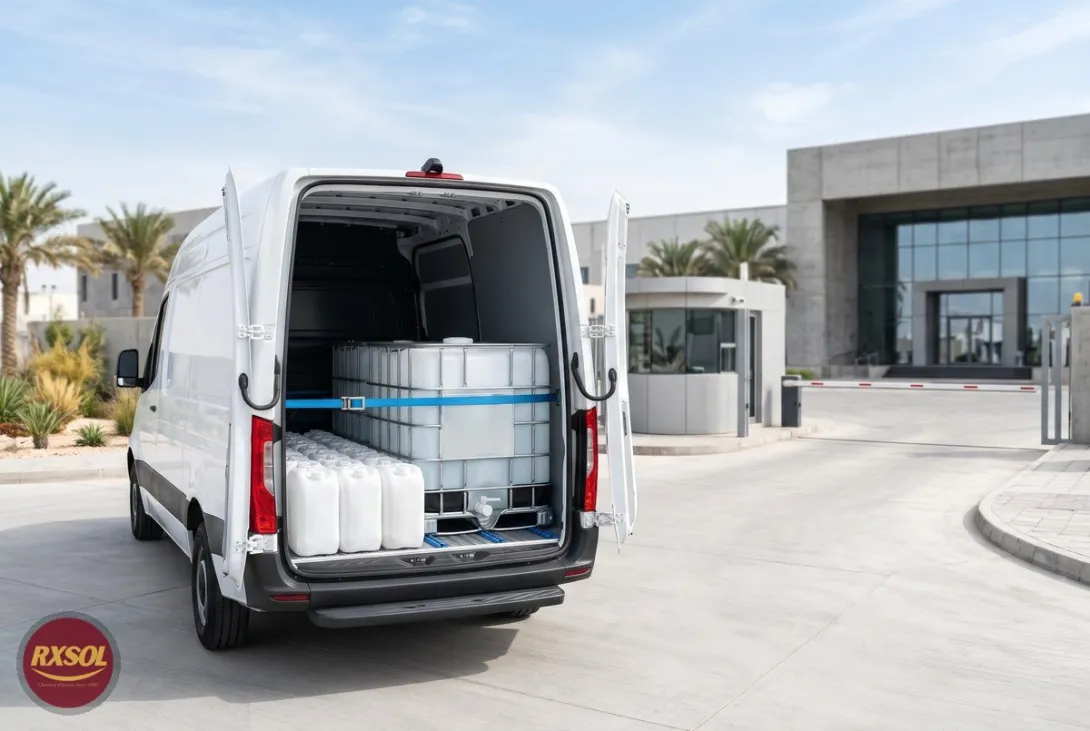
For this product class, common packing runs from 25 L jerrycans to 1,000 L IBCs and bulk road tankers. Tell us your volume, delivery site and the grade your equipment needs, and we will confirm the packing, part number and delivery on your quote. Full details are on our demineralised water product page and the DM water D.M WATER listing, and you can browse our full chemical range.
Frequently asked questions
Is demineralised water the same as distilled or deionised water?
Deionised and demineralised water are the same product. Distilled water is made by boiling and condensing. Ion exchange does not remove uncharged organics or bacteria, so DM water is not sterile, and where purity rules are strict, distilled or ultrapure water is used.
Can I use tap water instead of demineralised water to top up batteries?
No. Tap or tank water contains minerals and salts that can drastically shorten the life of a lead-acid battery. Use demineralised or battery-grade water in car, forklift and ship batteries.
What conductivity should demineralised water have?
Typical industrial DM water is about 1 to 10 µS/cm, and our standard grade is specified at < 10.0 Micromohms/cm. Lab grades are typically below about 1.5 µS/cm, and IS 1069:2021 battery water has a maximum of 0.5 µS/cm at 25°C.
How long can demineralised water be stored?
Typical shelf life is 12 to 18 months from the batch date. Keep it tightly sealed in plastic containers, upright and away from direct sunlight.
To order demineralised water for your Muscat site, request a quote or send your volume and location on WhatsApp at +968 77333599.
Frequently asked questions
Is demineralised water the same as distilled or deionised water?
Deionised and demineralised water are the same product. Distilled water is made by boiling and condensing. Ion exchange does not remove uncharged organics or bacteria, so DM water is not sterile, and where purity rules are strict, distilled or ultrapure water is used.
Can I use tap water instead of demineralised water to top up batteries?
No. Tap or tank water contains minerals and salts that can drastically shorten the life of a lead-acid battery. Use demineralised or battery-grade water in car, forklift and ship batteries.
What conductivity should demineralised water have?
Typical industrial DM water is about 1 to 10 µS/cm, and our standard grade is specified at < 10.0 Micromohms/cm. Lab grades are typically below about 1.5 µS/cm, and IS 1069:2021 battery water has a maximum of 0.5 µS/cm at 25°C.
How long can demineralised water be stored?
Typical shelf life is 12 to 18 months from the batch date. Keep it tightly sealed in plastic containers, upright and away from direct sunlight.