
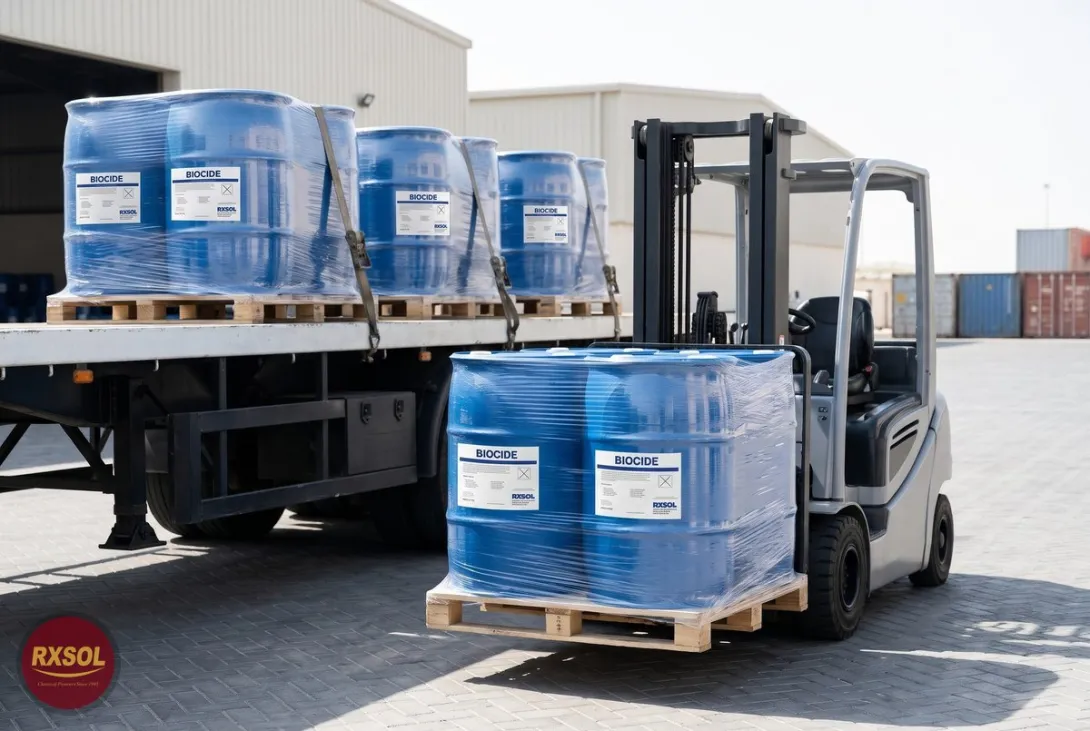
How to choose and dose a biocide for cooling towers, closed chilled water loops and storage tanks in Oman, with worked dosing examples, test targets and supply from our Barka warehouse.
If slime is building in your cooling tower, the chiller loop smells of rotten eggs or a rooftop tank has turned cloudy, the fix is a biocide matched to the system. Biocide water treatment kills bacteria, algae and fungi in circulating and stored water. The grade you need depends on whether the water is open to air, sealed in a closed loop or held in a tank. For buyers in Muscat we supply three water grades from Barka Industrial Area: a cooling tower biocide, a closed loop biocide and an oxidising sanitiser.
What biocide water treatment does in an Omani plant
Bacteria grow fast in warm, aerated water. Without treatment, planktonic counts in an open cooling tower running at 25-40°C can climb past 106 CFU/mL. That growth forms biofilm on fill packs and exchanger tubes, cuts heat transfer, shelters sulphate reducing bacteria (SRB) that drive corrosion under deposits, and in cooling towers creates the conditions for Legionella.
Oman makes this harder. Summer basin temperatures of 45-50°C, pH between 6 and 10 and groundwater makeup with TDS of 3,000-8,000+ ppm all raise microbial and fouling risk. A dose that keeps a tower clean in January can fall short in June, so plan for higher demand and closer testing through the hot months.
Oxidising and non-oxidising biocides: which one you need
Water treatment biocides fall into two classes. Oxidising biocides such as sodium or calcium hypochlorite, bromine, chlorine dioxide, ozone and hydrogen peroxide act fast. Non-oxidising biocides such as isothiazolinones, glutaraldehyde, DBNPA and quaternary ammonium compounds act more slowly and more selectively, and leave a longer residual.
Most open cooling towers run a dual programme: a continuous oxidiser for daily control plus a periodic non-oxidising shock dose to clear biofilm. Closed loops and chilled water systems running below 60°C use a closed-circuit biocide instead, and a non-oxidising isothiazolinone is the common default.
Choosing the grade: cooling tower, closed loop or sanitiser
Our cooling tower biocide, part number RXSOL-40-4008-020, is a clear, colourless liquid for marine and industrial circulating cooling water in open and closed loops. Its SDS lists the reaction mass of 5-chloro-2-methyl-2H-isothiazol-3-one and 2-methyl-2H-isothiazol-3-one (CAS 55965-84-9) at 1-3%, which puts it in the isothiazolinone family. Our product record also lists drinking water treatment and the disinfection of cisterns, tanks and pipes.
The closed loop biocide RXSOL-40-4008-027 is made for engine jackets, chiller water circuits, glycol brine systems, hot water circuits, engine coolant and process chilling and heating. It targets sulphate reducing bacteria and the aerobic and anaerobic bacteria found in sealed circuits.
The biocide sanitiser in 25 litre packs, RXSOL-40-4008-025, is an oxidising disinfectant. It breaks up into water and free oxygen radicals, which oxidise the cell membranes of micro-organisms. We supply it for UF and RO membrane sanitising, dairy, beverage and food plants, hatcheries and wastewater odour control.
| Item | Cooling tower biocide | Closed loop biocide | Biocide sanitiser |
|---|---|---|---|
| Part number | RXSOL-40-4008-020 | RXSOL-40-4008-027 | RXSOL-40-4008-025 |
| Application | Circulating cooling water, open and closed loops; cisterns, tanks and pipes | Engine jacket, chiller water, glycol brine, hot water circuit, engine coolant | UF and RO membranes, dairy, beverage and food plants, wastewater odour control |
| Dosage | Typical for the isothiazolinone class: 50-100 ppm shock every 3-7 days; 100-200 ppm for fouled systems | Depends on system type, fluid and operating conditions; the specific rate is set by the technical representative | Contact us for dosing guidance |
| Packing | On request | On request | 25 litres |
| Technical specs | Clear, colourless liquid, characteristic odour | Liquid, specific gravity 1.0 to 1.2 depending upon product, completely soluble in water | Clear colourless liquid, strong pungent odour |
| MSDS | On request | On request | On request |
Cooling tower biocide dosage and shock schedule
A typical oxidising programme trims sodium hypochlorite to 0.2-0.5 ppm free halogen residual for at least 4 hours a day. Stay inside that band: residuals above 0.5 ppm free can corrode copper alloys. Halogen demand is typically 2-5 ppm for river or canal makeup water and under 1 ppm for clean municipal water, so test your own makeup before you set the chlorine feed.
Typical non-oxidising shock dosing is 50-100 ppm of product every 3-7 days, held 4-8 hours before blowdown, with the non-oxidiser rotated every 2-4 weeks to prevent resistance. For a fouled system, at start-up or where biomass is visible, some isothiazolinone products recommend an initial shock of 100-200 ppm, repeated once or twice weekly as needed.
Non-oxidising biocides are dosed on system volume. A tower holding 100 m³ of water, about 100,000 kg, needs 5 kg of product at 50 ppm and 10 kg at 100 ppm. With a specific gravity of typically about 1.03 for this class, that is roughly 4.9 to 9.7 litres per shock. Where you know the system half-life, hold the dose for at least twice that figure: a 6-hour half-life means at least 12 hours before blowdown.
Closed loop and chilled water biocide dosing
Treat a closed system from first fill, ideally by dosing the fill water in a tank, then flush it, chemically clean within 24 hours of flushing and follow with corrosion inhibitor and biocide. One closed-system guideline gives about 200-500 ml per 1,000 litres of system water every three months for chilled and LTHW systems, with more frequent dosing where water turnover is high. For a 20,000 litre chilled water loop in a Muscat office block, that works out at 4 to 10 litres per quarter.
Match the active to the loop temperature and pH. Typical working ranges are isothiazolinone (about 1.5%) pH 4-8 below 50°C, DBNPA (about 20%) pH 6-8.5, bronopol pH 4-8 below 60°C, THPS pH 3-10 below 60°C and glutaraldehyde (about 24%) pH 7-10 below 50°C. A hot water circuit above 50°C therefore needs a different active from a chilled water loop.
A single shock dose rarely kills all bacteria in a heavily contaminated loop, because they survive under biofilm. A rotten-egg smell at the drain points to SRB: clean the loop, then repeat the dose. Shock-dose before any seasonal shutdown as well.
Sanitising water storage tanks
Rooftop and underground tanks in Muscat villas and buildings sit in summer heat for weeks and can grow slime and odour. Drain the tank, scrub sediment and biofilm off the walls and floor, refill, dose the biocide at the rate and contact time given in the product's technical data, and hold for the stated contact time. Then drain and flush with clean water before the tank returns to service. For tanks that feed drinking water, tell us before you order so we confirm the right grade.
Testing, compatibility and safe handling
Typical weekly cooling tower targets are total bacteria below 104 CFU/mL (action level 105), free halogen (DPD) 0.2-0.5 ppm during dosing and below 0.1 ppm off-time, and ORP 600-700 mV during oxidiser dosing. ORP below 450 mV indicates the biocide is exhausted. Your maintenance team can run dipslides, a DPD test kit and an ORP probe on site. Check closed systems with dipslides at least monthly for Pseudomonas, SRB, nitrite-reducing bacteria and total viable count, and bring the next dose forward if growth shows.
DBNPA-class biocides are compatible with most water treatment chemicals except strong reducing agents. Send us the names of the corrosion and scale inhibitors already in your system and we check compatibility before you change the biocide.
Liquid isothiazolinone biocides are typically labelled corrosive and irritant. Wear gloves and eye protection, wash skin with plenty of water on contact, and seek medical help if swallowed. Check the SDS H-statements, including skin sensitisation. Keep containers tightly closed in a dry, well-ventilated place, out of direct sunlight and away from combustible materials, which in an Omani summer means a shaded store. Isothiazolinones are flagged as potentially bio-accumulative, so check your blowdown discharge limits with the Environment Authority before you fix a programme.
Where to buy biocide water treatment chemicals in Muscat and Oman
Muscat Chemical (Muscat & Barka for Business Trading) supplies these grades from Barka Industrial Area, Sultanate of Oman, to plants, hotels and buildings in Muscat and across Oman. Contact us to confirm supply to your site. The same cooling tower biocide is also listed on our Sohar site, and southern sites can look at our Salalah page for Dhofar and Salalah port. The SDS is available on request. Call +968 77333599 or email muscatchem@gmail.com.
Frequently asked questions
How often should biocide be added to a cooling tower?
A typical programme holds an oxidiser at 0.2-0.5 ppm free halogen for at least 4 hours a day and adds a non-oxidising shock of 50-100 ppm every 3-7 days, rotating the non-oxidiser every 2-4 weeks.
Does biocide kill Legionella in cooling towers?
Preventing Legionella growth is a main reason to dose cooling tower biocide, but no biocide combination guarantees 100% prevention and quaternary ammonium compounds alone are reported to be ineffective against it. Monitor Legionella levels alongside total bacteria.
Which biocide is best for a closed loop chilled water system?
Loops below 60°C use a closed-circuit biocide, with a non-oxidising isothiazolinone as the common default where the loop stays below 50°C and pH 4-8. Our closed loop grade is RXSOL-40-4008-027.
Can biocide and corrosion inhibitor be dosed together?
Closed systems are normally dosed with both corrosion inhibitor and biocide after cleaning. Keep oxidiser residuals at or below 0.5 ppm free to protect copper alloys, and send us your inhibitor details so we confirm compatibility.
Where can I buy cooling tower biocide in Muscat?
We supply it from Barka Industrial Area, Sultanate of Oman. Call or WhatsApp +968 77333599 for a quote.
Request a quote: send your system volume, makeup water source and current treatment on WhatsApp at +968 77333599 or through our quote request page, and we reply with the grade, dose and pack size for your site.
Frequently asked questions
How often should biocide be added to a cooling tower?
A typical programme holds an oxidiser at 0.2-0.5 ppm free halogen for at least 4 hours a day and adds a non-oxidising shock of 50-100 ppm every 3-7 days, rotating the non-oxidiser every 2-4 weeks.
Does biocide kill Legionella in cooling towers?
Preventing Legionella growth is a main reason to dose cooling tower biocide, but no biocide combination guarantees 100% prevention and quaternary ammonium compounds alone are reported to be ineffective against it. Monitor Legionella levels alongside total bacteria.
Which biocide is best for a closed loop chilled water system?
Loops below 60°C use a closed-circuit biocide, with a non-oxidising isothiazolinone as the common default where the loop stays below 50°C and pH 4-8. Our closed loop grade is RXSOL-40-4008-027.
Can biocide and corrosion inhibitor be dosed together?
Closed systems are normally dosed with both corrosion inhibitor and biocide after cleaning. Keep oxidiser residuals at or below 0.5 ppm free to protect copper alloys, and send us your inhibitor details so we confirm compatibility.
Where can I buy cooling tower biocide in Muscat?
We supply it from Barka Industrial Area, Sultanate of Oman. Call or WhatsApp +968 77333599 for a quote.