Which antifoam defoamer grade to order in Oman for ETP effluent, car wash pits and scrubber recovery tanks. Covers dosing, storage in summer heat and delivery from Barka.
Foam spilling from an aeration tank, a car wash recycling pit or a floor scrubber recovery tank stops work and spreads across the floor. As an antifoam defoamer supplier in Oman, we supply silicone and silicone-free grades from Barka Industrial Area. For most effluent and wash water jobs, start with our silicone emulsion RXSOL-16-2066-210. Trial a silicone-free grade where silicone carryover into discharged water is a concern, and begin at a low dose before you adjust.
Antifoam vs Defoamer: What the Product Does
A defoamer breaks foam that is already there. An antifoam stops new foam from forming. Most products sold under either name do both jobs.
The active part does not dissolve in the foaming liquid, but it is surface-active. It has a low viscosity, so it spreads quickly over the bubble surfaces and thins the bubble walls until they break. The trapped air then joins into larger bubbles that rise and escape. Typical active ingredients are insoluble oils, silicones such as polydimethylsiloxane, certain alcohols, stearates and glycols.
Why Foam Builds Up in ETP and Wash Water Tanks
In a biological effluent treatment plant (ETP), foam comes from two sources: bacteria breaking down organic matter, and the air blown in for aeration. That foam blocks filters, cuts oxygen transfer to the microbes and can interfere with disinfection. Controlling foam in the aeration tank is part of keeping the plant running.
In wash water, the source is mostly detergent and shampoo. It ends up in the recycling tank of a car wash or truck wash bay, the recovery tank of a floor scrubber or carpet extractor, or a laundry effluent sump. Each time the water falls into a sump or passes through a pump, more air is drawn in and the foam grows.
Check the physical causes alongside dosing. Reduce the free fall of water into the sump, look for a pump suction that is drawing air, and mix cleaning solutions at the strength on their label.
Silicone vs Non-Silicone Defoamer: Which Grade to Choose
Silicone defoamers are hydrophobic silica dispersed in silicone oil with emulsifiers, supplied as an oil or a water emulsion. They are heavy duty and act on both surface foam and entrained air. They work at low doses and usually knock foam down fastest. Non-silicone defoamers are based on mineral oil or on EO/PO block copolymers (polyethylene glycol and polypropylene glycol). You choose them where silicone residue in discharged effluent, rinse water or a downstream process is not acceptable.
Use this as a starting point:
- Car wash pits, truck wash bays, and floor scrubber and carpet extractor recovery tanks: our silicone antifoam emulsion RXSOL-16-2066-210, which may be used as received or diluted.
- ETP aeration tanks, clarifiers and DAF units where your discharge or reuse limits rule out silicone: our silicone-free antifoam defoamer RXSOL-40-2066-025, after a jar trial on your own effluent.
- Amine and glycol dehydration units at gas plants: RXSOL-16-2066-025 or RXSOL-40-2066-025. Both stay stable as salts build up in these units.
- Seawater distillation and desalination: Antifoam Defoamer Elite M8 for desalination plants (RXSOL-16-2066-200).
The table shows the data we hold for each grade. Figures marked typical come from published data sheets for this type of product. They are not measured values for our batch. Ask us for the MSDS of the grade you need.
| Part number | Type | Application | Dosage | Technical specs |
|---|---|---|---|---|
| RXSOL-16-2066-210 | Proprietary blend of silicon emulsion and non hazardous ingredients | Water treatment, cleaning compounds, food processing, pulp and paper, oil and gas, mining | Used as received or diluted. Typical for recovery tank silicone defoamers: about 1 oz per 5 US gallons (about 30 mL per 19 L) | Liquid, faint odour |
| RXSOL-40-2066-025 | Silicone free | Amine and glycol units in gas plants; effluent after a trial | Typical for non-silicone effluent defoamers: about 5 to 50 mg/L | Liquid, clear, faint odour, pH 7, boiling point >85 C, flash point closed cup 229.4 C (444.9 F) |
| RXSOL-16-2066-025 | Polyether polyol (CAS 9003-11-6) 60-80%, proprietary blend 20-40% | Amine and glycol dehydration units, gas recovery and LNG plants | On request | Liquid, clear, faint odour, pH 7, boiling point >85°C, flash point closed cup 229.4°C (444.9°F) |
| RXSOL-16-2066-200 | Modified alcohols and polymerised glycol ethers | Seawater distillation and desalination | 0.05 - 0.1 mg/l in the seawater feed | Clear to pale yellow liquid, water content 4-5% w/w, ready dispersible white milky emulsion, specific gravity at 25°/25°C 1 |
Dosage, Dilution and Overdosing
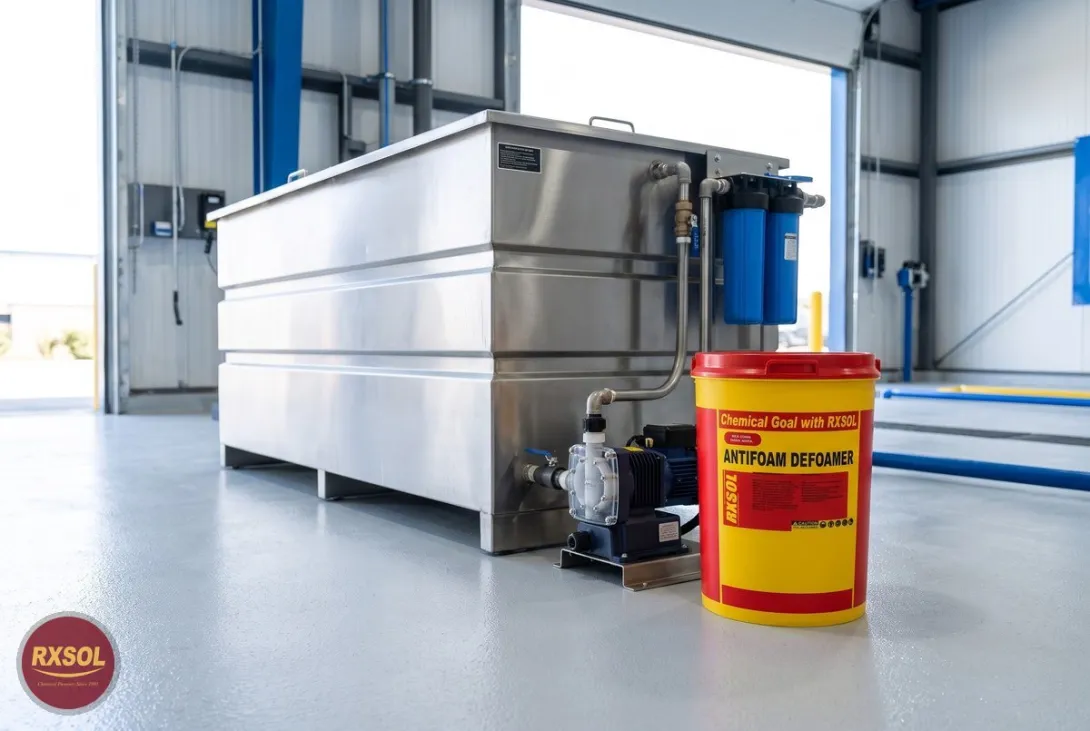
Dose at the point where foam starts. In an ETP that is the aeration tank inlet. In a wash bay it is the sump or recycling tank, and on a scrubber it is the recovery tank before the machine runs. For non-silicone effluent defoamers, a typical wastewater dose is about 5 to 50 mg/L, depending on the system. For ready-to-use silicone defoamers in recovery tanks, a typical dose is about 1 oz per 5 US gallons of tank capacity (about 30 mL per 19 L). Shake the drum before use. You can also spray heavy foam directly with defoamer.
Run a jar test before you set a plant dose. Fill a closed bottle with your effluent or wash water, shake it, and note the foam height and how long the foam takes to drain. Repeat with small, measured additions of defoamer until the foam collapses quickly, then scale that ratio to your flow. Start the plant at the low end and adjust in steps.
Many silicone antifoam emulsions can be diluted with water before dosing, while others go in neat, so follow the data sheet for the grade. If you dilute, use clean water and make up only what you will use that shift.
Set the dose with care. Overdosing wastes product, and wrong use can upset biological treatment and microbial activity in an activated sludge plant. If foam comes back after a period of good control, check three things: whether the detergent load or aeration rate has changed, whether you are still dosing ahead of the foam, and whether the product in the drum has separated. Repeated freezing or overheating can separate an antifoam emulsion and make it unusable.
Storage in Oman Heat, Shelf Life and Handling
Silicone antifoam emulsions are typically stored at about 5 to 30 °C in sealed containers, and they must not freeze. Some data sheets set an upper limit of about 32 °C. In an Oman summer, a drum left in the sun at a site in Barka, Sohar or Muscat can get hotter than that. Keep drums indoors and in shade, off the open yard, with the lids tightly closed.
Typical shelf life for antifoam emulsions is about 6 to 12 months from manufacture in unopened containers, so order in line with your use. These products are generally non-corrosive to equipment. Spills make floors slippery, so clean them up straight away. Some people are sensitive to the ingredients, so read the label and MSDS before use.
Antifoam Defoamer Supplier in Oman: Where to Buy in Muscat
Muscat Chemical (Muscat & Barka for Business Trading) supplies antifoam defoamer from Barka Industrial Area, Sultanate of Oman. Call +968 77333599, message us on WhatsApp or email muscatchem@gmail.com. Send us your site location and we will confirm delivery in the quotation.
For Sohar port and Batinah industrial sites, the same RXSOL-16-2066-210 grade is listed on our Sohar antifoam defoamer page. Buyers in Dhofar can use the Salalah antifoam defoamer page.
When you request a quote, tell us the application, your tank volume or flow, and your monthly use. We will confirm the grade, packing and delivery in the quotation. Ask for the MSDS of the grade you need. If your site needs a COA or other documents, list them in your request.
Frequently Asked Questions
Should I use silicone or non-silicone defoamer for effluent treatment?
Silicone grades usually knock foam down fastest at low doses. Choose a non-silicone grade, based on mineral oil or EO/PO copolymers, where silicone residue in discharged effluent or reused water is not acceptable. A jar trial on your own effluent settles the choice.
How much defoamer should I dose in wastewater?
For non-silicone effluent defoamers, a typical dose is about 5 to 50 mg/L, depending on the system. Start low, measure the foam height, and increase in small steps.
Can defoamer harm the bacteria in an activated sludge plant?
Wrong use, including overdosing, can upset biological treatment and microbial activity. Set the dose carefully, prefer biodegradable low-toxicity grades and keep monitoring the plant after you start dosing.
Can I dilute antifoam emulsion with water before dosing?
Many silicone antifoam emulsions can be diluted with water, while others are added neat. Our RXSOL-16-2066-210 may be used as received or diluted for specific applications. Use clean water and dilute only what you will use soon.
Request a quote for antifoam defoamer on WhatsApp at +968 77333599. Send your application and monthly volume, and we will reply with the right grade and delivery details.
Frequently asked questions
Should I use silicone or non-silicone defoamer for effluent treatment?
Silicone grades usually knock foam down fastest at low doses. Choose a non-silicone grade, based on mineral oil or EO/PO copolymers, where silicone residue in discharged effluent or reused water is not acceptable. A jar trial on your own effluent settles the choice.
How much defoamer should I dose in wastewater?
For non-silicone effluent defoamers, a typical dose is about 5 to 50 mg/L, depending on the system. Start low, measure the foam height, and increase in small steps.
Can defoamer harm the bacteria in an activated sludge plant?
Wrong use, including overdosing, can upset biological treatment and microbial activity. Set the dose carefully, prefer biodegradable low-toxicity grades and keep monitoring the plant after you start dosing.
Can I dilute antifoam emulsion with water before dosing?
Many silicone antifoam emulsions can be diluted with water, while others are added neat. Our RXSOL-16-2066-210 may be used as received or diluted for specific applications. Use clean water and dilute only what you will use soon.