Before you order carbon for a water filter plant in Oman, settle the grade, iodine number, mesh, bed depth and documents. This guide covers each one and explains how to order from our Barka warehouse.
A carbon filter that lets chlorine or organics through puts your RO membranes and your product water at risk. Start by getting the grade, mesh and test figures in writing before the bags arrive. We supply granular activated carbon for water filter plants from Barka Industrial Area, Sultanate of Oman. To order the right carbon you need five things: the base material, the iodine number, the mesh size, the bed volume and the documents that come with each lot.
Why water filter plants in Oman use activated carbon
Granular activated carbon (GAC) does two jobs in drinking water treatment. It adsorbs organic contaminants, and it removes the free residual chlorine left over from pre-disinfection. Organics matter because they react with many disinfectants, especially chlorine.
Carbon filtration reduces taste, odour, chlorine and colour. It also removes organics such as benzene, phenol, pesticides and herbicides. It does not remove ammonia, calcium or nitrates, so a carbon bed will not fix hardness or nitrate in your feed water.
Common duties for activated carbon in water plants include dechlorination ahead of RO membranes, a polishing stage after desalination, and tertiary filters in STP and ETP plants. In those tertiary filters, carbon adsorption is a proven way to remove organic compounds from biologically treated wastewater.
Coal-based or coconut shell: what to ask your activated carbon supplier
Coal-based carbon is the general-purpose choice for water treatment. Coconut shell carbon is chosen where hardness, low ash or a neutral taste matters, as in gold recovery, pharma and food. Wood-based carbon suits decolourising of sugar and dyes.
These typical figures help you write a tender spec or compare offers:
- Iodine number: typically 900 to 1100 mg/g for coal-based water treatment GAC and 1050 to 1300 mg/g for coconut shell GAC. Iodine number is tested by ASTM D4607.
- Ash content: typically 8 to 15% for coal-based carbon and 2 to 5% for coconut shell carbon.
- Ball-pan hardness (ASTM D3802): typically 92 to 95% for coal-based and 96 to 99% for coconut shell grades.
- Mesh: municipal polishing specs often call for at least 900 mg/g in 8x30 mesh (about 0.6 to 2.4 mm).
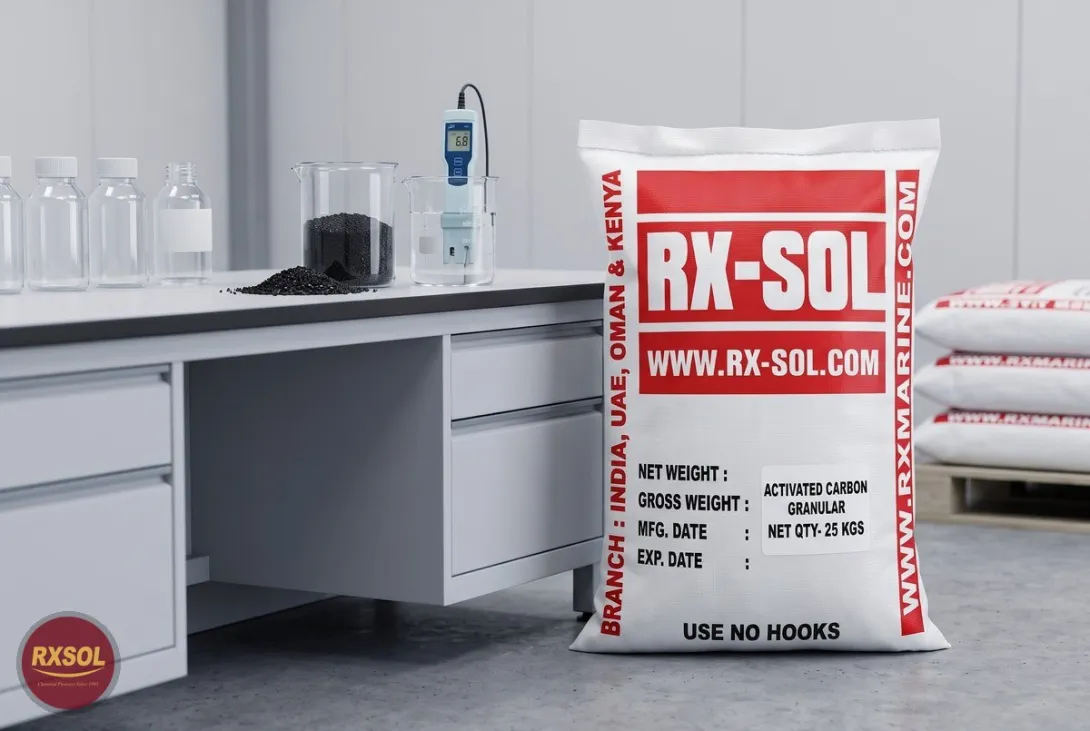
Iodine number tracks micropore capacity for small molecules. Methylene blue number tracks capacity for larger molecules, so ask for both if your water carries colour. Our record for activated carbon granular lists mesh sizes 4X8, 8X16,16X32, and other sizes can be set as per requirement.
Granular, powdered, bead and food grade: choosing the form
Granular carbon has larger particles than powdered carbon and a smaller external surface, so the rate at which contaminants diffuse into each granule is an important factor. GAC is used for water treatment, deodorisation and separating components in flow systems, and it comes in granular or extruded form. See our granular activated carbon GAC.
Powdered activated carbon (PAC) is typically 200 to 325 mesh (about 45 to 75 µm). It is dosed in batches to remove colour, smell and impurities from products such as sugar, glucose and fine chemicals, then filtered out.
Activated charcoal bead is spherical carbon. Its edgeless shape gives low pressure drop across a bed and low abrasion and dusting. Beads are typically about 0.1 to 1 mm across and are used in vehicle cabin filters, gas masks and building air filters.
Food grade activated charcoal is used for decolourising, taste and odour removal and purification in food processing. Food grade (FCC) carbon must have an iodine number of at least 400, lead of no more than 10 mg/kg and water extractables of no more than 4.0%.
| Product | Part number | Typical use | Data on our record |
|---|---|---|---|
| Activated Carbon Granular GAC | RXSOL-32-3107-080 | Drinking water, tertiary wastewater filters | pH: 4.0-6.0; Solubility: Negligible (water, oil); Flash Point: Not flammable |
| Activated Carbon Granular | RXSOL-26-3107-055 | Water purification filters | Mesh Size 4X8, 8X16,16X32; pH: 4.0-6.0; Specific Gravity: .22-.32 |
| Activated Carbon Charcoal Food Grade | RXSOL-26-3107-025 | Decolourising and purification in food processing | pH: 4.0-6.0; Type: Charcoal |
| Activated Charcoal Bead | RXSOL-26-3107-027 | Air and gas filters, low dusting beds | Grade data on request |
| Calcined Anthracite Coal | RXSOL-26-3107-026 | Recarburiser for steel and foundry | Grade data on request |
Anthracite filter media and calcined anthracite are different products
Anthracite filter media sits over sand in dual-media and multimedia filters. It is typically about 96% carbon with a specific gravity of about 1.6. Because it is lighter than sand, it gives longer filter runs and lower head loss. A typical multimedia filter has about 60 cm anthracite on top, 30 cm sand and 15 cm garnet, and runs at about 5 to 10 m/h. Common standards are AWWA B100 and EN 12909.
Calcined anthracite coal is anthracite treated at high temperature to drive off volatile matter and moisture. It is mainly used as a carbon raiser (recarburiser) in steelmaking and ductile-iron foundries, especially in electric furnaces. Do not order it as filter media.
Bed depth, contact time and when to change the carbon
A typical GAC filter has a 60 to 90 cm bed with an empty bed contact time (EBCT) of about 8 to 15 minutes at 5 to 15 m/h. To get EBCT in minutes, divide the bed depth in metres by the filtration rate in m/h and multiply by 60. A 0.9 m bed at 6 m/h gives 9 minutes. Work out the bag count from your vessel diameter, bed depth and the bulk density of the grade you choose.
Carbon removes free chlorine by a chemical reaction, far more readily than it adsorbs organics, so organics break through long before chlorine shows in the treated water. In one worked example at 1 mg/L chlorine and 5 min EBCT, the bed held organics for about 12 months and chlorine for 2 to 3 years. The practical rule is to change the carbon every year. An exhausted bed can release trapped contaminants, so replace it before it is fully exhausted.
Use the annual change to inspect the vessel, repair valve leaks, renew internal epoxy coatings and backwash correctly so the bed does not cake. Without regular disinfection, bacteria can grow in a moist carbon bed. Spent GAC can be thermally reactivated in steam at about 800°C. Each cycle loses roughly 5 to 15% of capacity, and carbon usually goes through 3 to 5 cycles.
Packing, storage, handling and documents
Activated carbon is typically shipped in 25 kg PE-lined woven bags, 500 to 600 kg jumbo bags or bulk. Store the bags dry below about 30°C and keep them off wet floors through the Muscat summer. Sealed shelf life is about 2 years, and opened bags should be used within 30 to 60 days because carbon absorbs moisture from the air.
Read the SDS before you charge a filter. Anthracite fines carry GHS health hazards because of crystalline silica content (Carc. 1A H350, STOT SE 3 H335, STOT RE 1 H372), so avoid breathing the dust when charging filters.
Ask for a COA for each lot. A COA typically covers iodine number, methylene blue, moisture, ash, bulk density, hardness, pH and heavy metals. When the delivery arrives, check that the lot number on the bags matches the COA, and that the iodine number and mesh match your purchase order.
Where to buy activated carbon in Muscat and across Oman
Muscat Chemical (Muscat & Barka for Business Trading), Barka Industrial Area, Sultanate of Oman. Phone +968 77333599, WhatsApp +968 77333599, email muscatchem@gmail.com.
The same food grade carbon is also listed on our Sohar site. Send your enquiry through our quote request page with the duty, vessel size, mesh and quantity.
Frequently asked questions
Where can I buy activated carbon in Oman for a water filter plant?
You can order from us at Barka Industrial Area. Send the vessel size, duty and mesh on WhatsApp +968 77333599 and we will respond to your enquiry.
What iodine number should activated carbon for drinking water have?
For drinking water, an iodine number of roughly 900 to 1100 mg/g is widely recommended. Municipal polishing specs often call for at least 900 mg/g in 8x30 mesh, tested by ASTM D4607.
How often should the carbon in a water treatment filter be changed?
The practical rule is once a year. Organics break through long before chlorine, so a filter that still removes chlorine can already be passing organics.
Does activated carbon remove chlorine?
Yes. Carbon removes free chlorine by a chemical reaction, and it does this far more readily than it adsorbs organics.
Can you deliver activated carbon to Sohar, Salalah or Duqm?
We have ready stock in Oman. Give us the site address and quantity with your enquiry and we will confirm delivery for your location.
Request a quote for activated carbon on WhatsApp +968 77333599 with your grade, mesh and quantity.
Frequently asked questions
Where can I buy activated carbon in Oman for a water filter plant?
You can order from us at Barka Industrial Area. Send the vessel size, duty and mesh on WhatsApp +968 77333599 and we will respond to your enquiry.
What iodine number should activated carbon for drinking water have?
For drinking water, an iodine number of roughly 900 to 1100 mg/g is widely recommended. Municipal polishing specs often call for at least 900 mg/g in 8x30 mesh, tested by ASTM D4607.
How often should the carbon in a water treatment filter be changed?
The practical rule is once a year. Organics break through long before chlorine, so a filter that still removes chlorine can already be passing organics.
Does activated carbon remove chlorine?
Yes. Carbon removes free chlorine by a chemical reaction, and it does this far more readily than it adsorbs organics.
Can you deliver activated carbon to Sohar, Salalah or Duqm?
We have ready stock in Oman. Give us the site address and quantity with your enquiry and we will confirm delivery for your location.