How to batch, run and test a citric acid passivation tank for stainless steel under ASTM A967. Covers how much powder to use per 1,000 L, chloride control in Oman make-up water, storage in coastal heat and 25 kg bag supply from Barka.
If welded or machined stainless steel shows rust spots soon after fabrication, its surface is carrying free iron, and a passivation tank filled with a citric acid powder solution is the standard way to remove it. For most tanks you dissolve 4-10 wt% citric acid in clean water, hold the bath in one of the ASTM A967 temperature bands and immerse the parts for at least 4 to 20 minutes, depending on the band. We supply citric acid powder, part number RXSOL-41-8926-025, in 25 kg multi-wall bags from Barka Industrial Area, Sultanate of Oman.
What citric acid passivation does to stainless steel
Stainless steel resists corrosion because of a thin, dense, chromium-rich oxide layer on its surface. Cutting, grinding, welding and handling with carbon steel tools leave free iron and other contaminants that break up that layer. Passivation removes the free iron and surface contaminants so the passive chromium oxide layer can form evenly. It deposits no coating, so dimensions and finish stay as they are.
Citric acid is a weak organic acid (C6H8O7, molecular weight 192.12 g/mol), commonly made by fermenting sugars. It is accepted for passivation under ASTM A967 and AMS 2700 (Method 2). It avoids nitric acid and hexavalent chromium (sodium dichromate) additives, which is why food, medical and pharma work often specifies it.
Compared with nitric acid, a citric line needs no special handling for toxic or highly corrosive fumes. Ventilation is suggested rather than required, and cycles run about 5-20 minutes instead of more than 20. Nitric acid resists flash attack better, so a citric bath needs cleaner water and closer control, as covered below.
Choosing citric acid powder: anhydrous, monohydrate and grade
Citric acid comes as anhydrous powder (CAS 77-92-9), as monohydrate (CAS 5949-29-1, with one water of crystallisation) and in granular form, in food, pharma and industrial or technical grades. Both anhydrous and monohydrate work in a passivation bath. The difference for your tank is weight: monohydrate carries water, so you add more of it to reach the same strength.
Typical assay for this product class is 99.5-100.5% on an anhydrous basis, with water at most 0.5% for anhydrous grade. ASTM A967 sets the bath concentration, not the grade, so technical grade citric acid suits most workshop tanks. If your client's QA plan for an oil and gas or food-plant job names a grade, put it in your enquiry and we will confirm the form and grade of the batch we ship.
The table combines our product record with typical values for this product class.
| Item | Detail |
|---|---|
| Part number | RXSOL-41-8926-025 |
| Chemical name and CAS | Citric acid, CAS 77-92-9 |
| Appearance | Free flowing white solid crystalline powder |
| Technical specs (typical) | Specific gravity 1.542; bulk density 63 lb/ft³; slightly hygroscopic; pH in water 1.87 |
| Application | Stainless steel passivation, limescale and boiler descaling, chelating, pH regulation; pH buffer and iron sequestration in drilling and workover fluids |
| Dosage (passivation, typical) | 4-10 wt% solution per ASTM A967 Citric 1, 2 and 3 |
| Packing | 25 kgs multi-wall bags |
| Hazard (class) | Eye Irritation Cat. 2A, H319, signal word Warning |
| MSDS | On request |
For uses outside passivation, such as limescale removal and water treatment, see our article on industrial and domestic uses of citric acid powder in Muscat.
Passivation tank mix: ASTM A967 concentration, temperature and time
ASTM A967 lists five citric options. The first three use a 4-10 wt% citric acid solution:
- Citric 1: 60-71 °C (140-160 °F) for at least 4 minutes.
- Citric 2: 49-60 °C (120-140 °F) for at least 10 minutes.
- Citric 3: 21-49 °C (70-120 °F) for at least 20 minutes.
- Citric 4 and Citric 5: conditions as qualified. Citric 5 sets a bath pH of 1.8-2.2.
Citric 3 runs at room temperature, and during a Muscat summer an unheated tank in an open workshop can drift towards the top of its band. Check the bath temperature with a thermometer before each load. If you heat a tank for Citric 1 or Citric 2, keep it inside the band for the whole immersion time.
How much citric acid powder per 1,000 L of tank water
The figures below are our own arithmetic for 1,000 L of make-up water (about 1,000 kg). Treat them as approximate:
- 4 wt%: about 42 kg anhydrous or about 46 kg monohydrate.
- 5 wt%: about 53 kg anhydrous (just over two 25 kg bags) or about 58 kg monohydrate.
- 10 wt%: about 111 kg anhydrous or about 122 kg monohydrate.
Monohydrate needs roughly 10% more powder because part of each bag is crystal water. Add the powder slowly to the water while stirring, let it dissolve fully, then check the pH before the first load.
Step-by-step tank procedure, testing and chloride control
- Degrease: remove oils and organic build-up from the parts, then rinse.
- Descale if needed. Passivation does not remove heat tint, weld scale or mill scale, so remove these first by acid pickling or by mechanical methods.
- Passivate: immerse the parts in the citric bath at the concentration, temperature and time of your chosen method.
- Rinse in DI water so no acid or chloride is left on the surface.
- Dry the parts, then test.
Testing passivated stainless steel
ASTM A967 verification tests include water immersion (12 cycles of 1 h wet and 1 h dry), high humidity (24 h at about 97% RH), salt spray (2 h per ASTM B117), copper sulfate (6 min) and potassium ferricyanide-nitric acid, where a blue colour within 30 s means free iron. Your customer's specification states which test applies.
Flash attack and make-up water in Oman
Chlorides in the bath cause flash attack, which shows up as etched or darkened parts. A commonly cited working chloride limit is about 60 mg/L. Chloride levels in Omani tap and desalinated water vary, so make up and top up your tank with DI or RO water. Log pH, temperature and immersion time for every load, and treat a drift in pH or concentration as the signal to top up or replace the bath under your qualified procedure.
Storage, safety and other uses in Oman
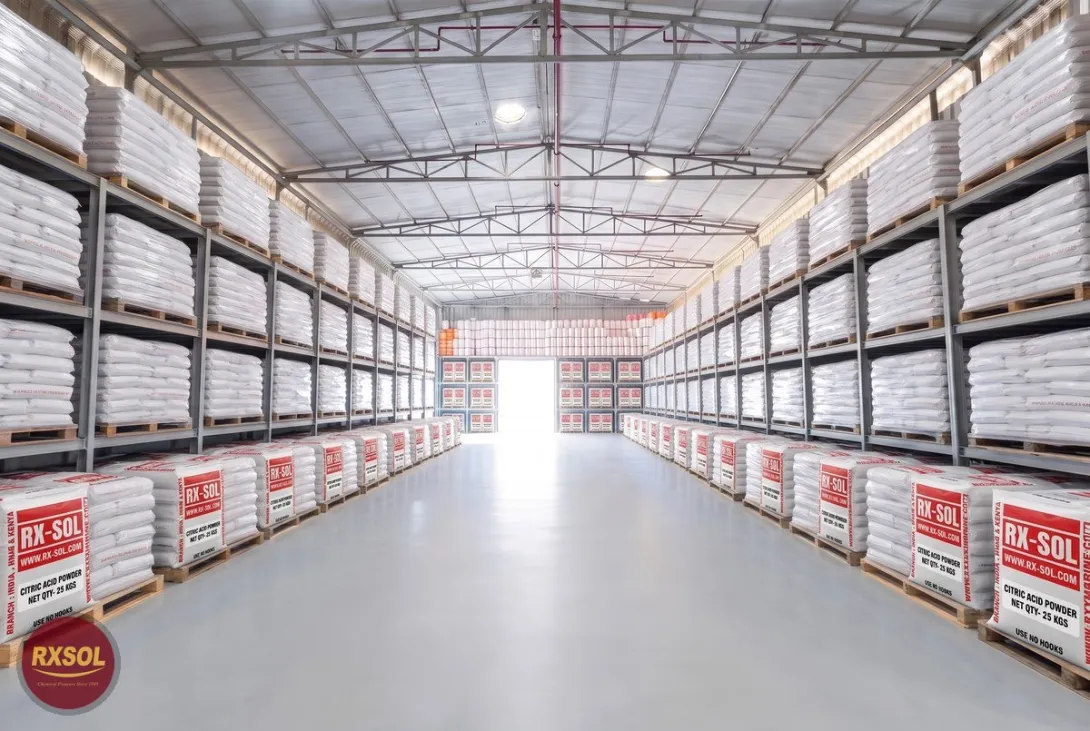
Citric acid powder is hygroscopic and moisture-sensitive, and it cakes when it picks up water. Store bags sealed in a dry, ventilated area, typically below about 30 °C and 65% relative humidity. Coastal sites from Sohar to Salalah are humid and warehouses get hot in summer, so keep the bags on pallets off the floor, reseal opened bags and use those first.
Under GHS, citric acid anhydrous is classified Eye Irritation Cat. 2A, H319 "Causes serious eye irritation", signal word Warning. Some SDSs add H335 (may cause respiratory irritation) for dust. Use goggles, gloves, an apron and a dust respirator when handling powder. It is non-combustible but gives off toxic fumes in a fire. Dispose of it by controlled landfill or as local rules require.
Descaling, ship tanks and hold cleaning
The same powder is used for limescale removal, boiler descaling, water treatment, chelating and pH regulation. In drilling and workover fluids it serves as a pH buffer and for iron sequestration, and treatment levels vary with salt concentration. In ship tanks and bilges, citric acid solutions of about 5-10% at pH about 3.5, sprayed hot, have been used to remove rust and scale as a milder alternative to hydrochloric acid.
Rock phosphate, slag and lime in cargo holds are a different job. Crews usually treat these deposits with a dedicated penetrating mixed-chemical cleaner such as our Rock Phosphate Ship Hold Cleaner, and scrub stubborn deposits to help the cleaning. Read the Material Safety Data Sheet before using this product.
Where to buy citric acid powder in Muscat and Oman
Muscat Chemical (Muscat & Barka for Business Trading) supplies citric acid powder, part number RXSOL-41-8926-025, in 25 kg multi-wall bags from Barka Industrial Area, Sultanate of Oman. Call +968 77333599, message us on WhatsApp or email muscatchem@gmail.com.
The same product is also listed on our Sohar Chemical site, and buyers in Dhofar can view it on our Salalah citric acid powder page.
When you ask for a quote, give us your tank volume, target concentration, preferred form (anhydrous or monohydrate) and the documents your QA needs. Full details are on the citric acid powder product page, and the rest of our range is in our product catalogue.
Frequently asked questions
What concentration of citric acid powder is used for stainless steel passivation?
ASTM A967 Citric 1, 2 and 3 use a 4-10 wt% citric acid solution. For a 1,000 L tank at 5 wt%, that works out at about 53 kg of anhydrous powder or about 58 kg of monohydrate.
What temperature and immersion time does citric acid passivation need?
Citric 1 runs at 60-71 °C for at least 4 minutes, Citric 2 at 49-60 °C for at least 10 minutes, and Citric 3 at 21-49 °C for at least 20 minutes. Citric 4 and 5 run as qualified.
Is citric acid safer than nitric acid for passivating stainless steel?
Citric acid needs no special handling for toxic or highly corrosive fumes, it avoids sodium dichromate additives and it is accepted under ASTM A967 and AMS 2700. Nitric acid resists flash attack better, so keep bath chlorides below about 60 mg/L and use DI or RO make-up water.
Does citric acid passivation remove weld heat tint and scale?
No. Passivation does not remove heat tint, weld scale or mill scale. Remove them first by acid pickling or by mechanical methods, then degrease and passivate.
Where can I buy citric acid powder in 25 kg bags in Muscat, Sohar or Salalah?
We supply RXSOL-41-8926-025 in 25 kg multi-wall bags from Barka Industrial Area, Sultanate of Oman. The same product is listed on our Sohar and Salalah sites. Call or WhatsApp +968 77333599.
To request a quote, send your tank size, concentration and grade on WhatsApp at +968 77333599 or through our quote request page.
Frequently asked questions
What concentration of citric acid powder is used for stainless steel passivation?
ASTM A967 Citric 1, 2 and 3 use a 4-10 wt% citric acid solution. For a 1,000 L tank at 5 wt%, that works out at about 53 kg of anhydrous powder or about 58 kg of monohydrate.
What temperature and immersion time does citric acid passivation need?
Citric 1 runs at 60-71 °C for at least 4 minutes, Citric 2 at 49-60 °C for at least 10 minutes, and Citric 3 at 21-49 °C for at least 20 minutes. Citric 4 and 5 run as qualified.
Is citric acid safer than nitric acid for passivating stainless steel?
Citric acid needs no special handling for toxic or highly corrosive fumes, it avoids sodium dichromate additives and it is accepted under ASTM A967 and AMS 2700. Nitric acid resists flash attack better, so keep bath chlorides below about 60 mg/L and use DI or RO make-up water.
Does citric acid passivation remove weld heat tint and scale?
No. Passivation does not remove heat tint, weld scale or mill scale. Remove them first by acid pickling or by mechanical methods, then degrease and passivate.
Where can I buy citric acid powder in 25 kg bags in Muscat, Sohar or Salalah?
We supply RXSOL-41-8926-025 in 25 kg multi-wall bags from Barka Industrial Area, Sultanate of Oman. The same product is listed on our Sohar and Salalah sites. Call or WhatsApp +968 77333599.