
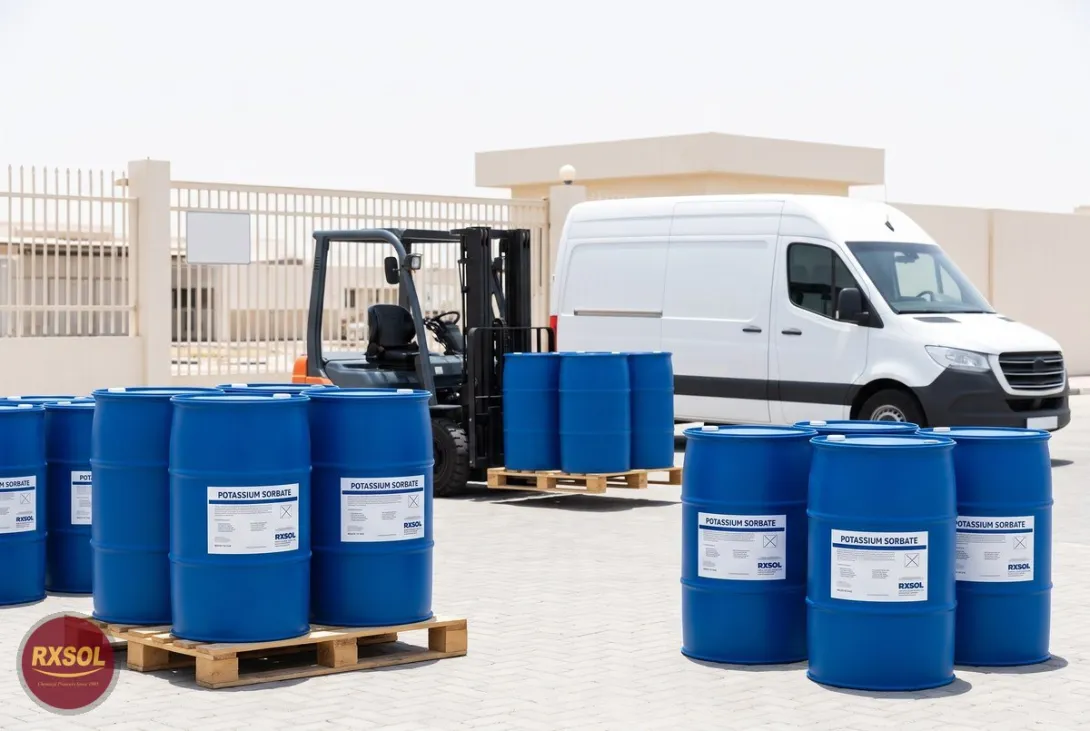
Potassium sorbate (E202) for bakeries and juice plants in Oman: which grade to order, typical dosage for cakes and beverages, why pH matters, storage in Oman's heat, and delivery from our Barka warehouse.
If mould is cutting the shelf life of your cakes, or yeast is refermenting your juice before it reaches the shelf, look at potassium sorbate (E202) first. As a potassium sorbate supplier in Oman, we supply from Barka Industrial Area to bakeries and juice plants in Muscat, Barka and Sohar. The short answer for a buyer is this. Ask for food grade with a COA, dose at a typical 0.025 to 0.10% of product weight, keep the product acidic and store the bags cool and dry.
What Potassium Sorbate (E202) Is and How It Works
Potassium sorbate is the potassium salt of sorbic acid (2,4-hexadienoic acid, potassium salt). Its formula is C6H7KO2, its CAS number is 24634-61-5 and its food additive number is E202 / INS 202. Manufacturers make it by neutralising sorbic acid with potassium hydroxide and then shaping it into pellets by extrusion. You will see it sold as powder, granules or pellets. It is white to off-white, has no smell and has a molecular weight of about 150.22.
It mainly stops moulds and yeasts and does little against bacteria. The free sorbic acid does the work, so it is most effective in acidic products, at about pH 3.0 to 5.5 and up to roughly pH 6.0 to 6.5. Above pH 6 its effect drops quickly, so sorbate on its own will not protect a product that is close to neutral.
The US FDA classes sorbic acid and potassium sorbate as Generally Recognised as Safe (GRAS) under 21 CFR 182, and the EU regulates them as E202. Each end product has a maximum legal level that must be followed. In Oman, check the GSO food additive limit for your product category. Our potassium sorbate product page gives part number RXSOL-60-6605-329 for your purchase order.
Which Grade to Buy: Food Grade (FCC/E202) or Lab Grade
Potassium sorbate is sold in three grades: food grade (FCC, E202), pharmaceutical grade (BP/USP/Ph Eur) and industrial or laboratory grade. Industrial or laboratory grade material does not belong in a bakery or juice line.
If you run a food plant, ask for FCC or E202 food grade and request the COA and Halal certificate with the quote. Tell us the end use when you enquire. We will confirm the grade and which documents come with that lot before you order. Keep these papers on file for Oman food safety inspections.
Check two figures on the COA first. For food grade material, the assay is typically 99.0 to 101.0% on a dried basis. The pH of a 10% solution in water is typically about 8.5 to 10.5, which is alkaline.
Potassium Sorbate in Bakery: Cakes, Fillings and Bread
In bakery, potassium sorbate is typically used in products raised with baking powder rather than yeast, such as cakes, muffins, icings and fillings. Dry-blend it with the flour at about 0.03 to 0.4% of batter weight. For example, a 0.1% dose in a 100 kg batch of batter is 100 g of potassium sorbate. Start at the low end and run your own shelf life trial before you fix the dose.
Do not use it in yeast-raised bread dough. It slows the yeast and reduces loaf volume. For bread and tortillas, spray a sorbate solution onto the surface after baking.
High baking temperatures can weaken its effect. Adding it after baking, or applying it to the surface, keeps the mould protection where you need it.
Potassium Sorbate in Juice and Beverage Plants
Juices and soft drinks typically sit at pH 3.0 to 4.0, which suits sorbate well. It stops yeast spoiling the product and stops it fermenting again in filled bottles and stored syrup. Typical use is about 0.003 to 0.03%. US FDA rules allow up to 0.1% (1,000 ppm) in some beverages. GSO limits apply in Oman, so confirm the permitted level for your drink before you fix the recipe.
For example, 0.003% of 1,000 kg of juice is 30 g, and 0.03% of 1,000 kg is 300 g. Beverage syrups, sauces, dressings and mayonnaise are other common uses, so confirm the dose and the legal limit for each product.
Potassium sorbate dissolves very easily in water, at about 58.2% at 20 °C. Dissolve it in water, or add it to the liquid part of the recipe, before mixing. On a juice line, a stock solution is the practical way to dose it. For a 10% stock, dissolve 1 kg in water and make it up to 10 kg of solution. Three kilograms of that stock then holds 300 g of potassium sorbate. The stock is alkaline, so check the pH of the finished batch after dosing.
Typical Specifications and Product Data
The values below are typical for this type of product, not the measured spec of a particular lot. Always check the COA that comes with your lot.
| Item | Detail |
|---|---|
| Part number | RXSOL-60-6605-329 |
| Chemical name | Potassium sorbate (2,4-hexadienoic acid, potassium salt) |
| CAS / E number | 24634-61-5 / E202, INS 202 |
| Formula and molecular weight | C6H7KO2, about 150.22 |
| Appearance | White to off-white, odourless powder, granules or pellets |
| Assay (typical, food grade) | 99.0 to 101.0% on a dried basis |
| pH of 10% solution (typical) | About 8.5 to 10.5 |
| Solubility in water | About 58.2% at 20 °C |
| Application | Preservative in foods, drinks and personal care products; stops mould and yeast |
| Typical dosage | 0.025 to 0.10% of product weight; bakery about 0.03 to 0.4% of batter weight; beverages about 0.003 to 0.03% |
| Packing | Small packs and bulk; usually traded in 25 kg HDPE or paper bags with an inner PE liner |
| Shelf life (typical) | About 24 months from manufacture in the unopened original pack |
Storage and Safe Handling in Oman's Climate
Keep potassium sorbate in a cool, dry place, ideally below 25 °C with low humidity and out of sunlight. In an Oman summer that means an air-conditioned store, not a container or a shed in the yard. Reseal opened bags tightly so the powder does not take up moisture and cake. This matters most with 25 kg bags that a bakery uses over several weeks.
The dust irritates the eyes, skin and airways (GHS H315, H319, H335, signal word "Warning"). Wear gloves and goggles, keep dust to a minimum and use local exhaust at the weighing point. It does not burn and is not regulated for transport (ADR, IATA). Keep it away from strong oxidisers and strong acids or alkalis. It has low toxicity if swallowed, with a typical LD50 of about 3,200 mg/kg in rats.
Potassium Sorbate Supplier Oman: Where to Buy in Muscat
Muscat Chemical (Muscat & Barka for Business Trading) supplies potassium sorbate from Barka Industrial Area, Sultanate of Oman, in small packs and in bulk. We supply food plants and bakeries in Muscat, Barka and Sohar. Our earlier potassium sorbate supply note for Ruwi, Mutrah, Nizwa and other towns has more on local supply.
If your QC lab also runs phosphate tests, see the molybdic acid LR listing on our Sohar site. The rest of the range is on our full product list.
Call +968 77333599, email muscatchem@gmail.com, or send your grade, quantity and delivery site through the quote request page.
Frequently Asked Questions
Where can I buy food grade potassium sorbate in Oman?
We supply potassium sorbate from Barka Industrial Area to Muscat, Barka and Sohar. Say that you need FCC or E202 food grade and ask for the COA and Halal certificate. We confirm the grade and the documents for the lot with the quote.
Can potassium sorbate be used in yeast-raised bread?
It is not recommended in yeast-raised bread dough because it slows the yeast and reduces loaf volume. For bread and tortillas, spray it onto the surface after baking.
How much potassium sorbate do I add to fruit juice?
Typical use in beverages is about 0.003 to 0.03%, which is 30 g to 300 g per 1,000 kg of juice. US FDA rules allow up to 0.1% (1,000 ppm) in some beverages, but check the GSO limit for your product in Oman first.
At what pH does potassium sorbate work best?
It works best in acidic products at about pH 3.0 to 5.5, and up to roughly pH 6.0 to 6.5. Its effect drops quickly above pH 6.
How should I store potassium sorbate and how long does it keep?
Typical shelf life is about 24 months from manufacture in the unopened original pack. Store it below 25 °C, dry and out of sunlight, and reseal opened bags tightly to stop caking.
To request a quote for potassium sorbate, send your grade, quantity and delivery location on WhatsApp to +968 77333599.
Frequently asked questions
Where can I buy food grade potassium sorbate in Oman?
We supply potassium sorbate from Barka Industrial Area to Muscat, Barka and Sohar. Say that you need FCC or E202 food grade and ask for the COA and Halal certificate. We confirm the grade and the documents for the lot with the quote.
Can potassium sorbate be used in yeast-raised bread?
It is not recommended in yeast-raised bread dough because it slows the yeast and reduces loaf volume. For bread and tortillas, spray it onto the surface after baking.
How much potassium sorbate do I add to fruit juice?
Typical use in beverages is about 0.003 to 0.03%, which is 30 g to 300 g per 1,000 kg of juice. US FDA rules allow up to 0.1% (1,000 ppm) in some beverages, but check the GSO limit for your product in Oman first.
At what pH does potassium sorbate work best?
It works best in acidic products at about pH 3.0 to 5.5, and up to roughly pH 6.0 to 6.5. Its effect drops quickly above pH 6.
How should I store potassium sorbate and how long does it keep?
Typical shelf life is about 24 months from manufacture in the unopened original pack. Store it below 25 °C, dry and out of sunlight, and reseal opened bags tightly to stop caking.