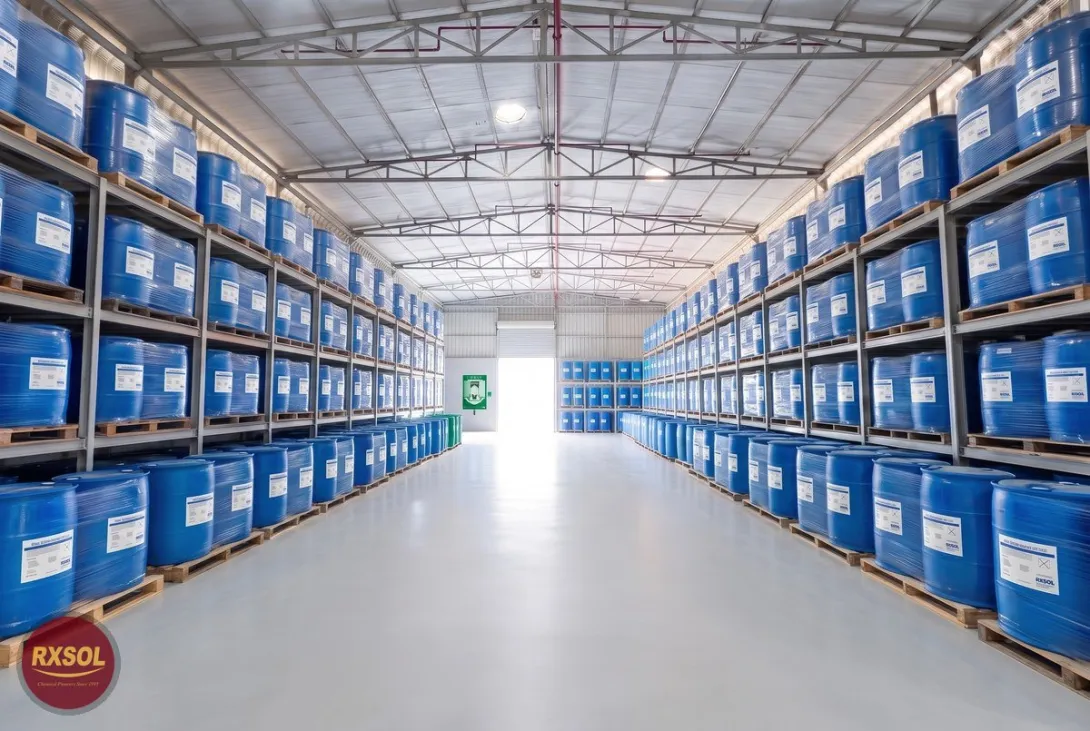
Chemical rust removal with Rust Stain Remover: which grade to order, a dilution chart for brush, spray and tank work, surface compatibility and safety. Supplied in 210 L drums from Barka to sites across Oman.
Rust bleeding from deck fittings, orange staining inside cargo tanks and rusted parts on a Muscat workshop bench all have the same fix: an inhibited acid rust stain remover. For chemical rust removal on steel, and for rust stains on stainless steel, brass, copper, aluminium, wood and ceramic, we supply Rust Stain Remover (RSR) in 210 L drums as well as 25 L and 35 L packs. You brush it on neat for heavy stains or dilute it with fresh water for light stains, leave it to react for 5-10 minutes, then rinse it off with a water jet.
How chemical rust removal works and which grade to order
Chemical rust removal uses an acid that reacts with iron oxide and dissolves the rust layer. This process is called pickling. Rust removers fall into three broad classes. Fast-acting strong acid products, typically around pH 1, handle medium to heavy rust. Mild acid products have a typical pH of about 2.5. Neutral-pH chelating removers bind the rust particles and lift them off the metal, and they are normally used by soaking the part.
RSR is in the acid class. The standard grade is a concentrated liquid blend of surfactants and organic compounds. It contains rust-penetrating agents, a solubiliser, inhibited phosphoric acid and ionic and non-ionic emulsifiers. The acid works on the rust while the inhibitor limits attack on the metal underneath. It is non-flammable, foams when used and also brightens aluminium and copper.
We stock two formulations. The standard grade is the one for heavy rust on steel, deck and plant work, and spot cleaning tank coatings after fats and fatty acids have been removed. Rust Stain Remover RSR ECO uses an inhibited organic acid instead of phosphoric acid, with an eco-friendly sulphonated alkyl foam detergent. If your vessel or plant keeps an approved chemical list, ask us for the MSDS of both grades and order the one your HSE team approves.
| Item | RSR standard | RSR ECO |
|---|---|---|
| Part number | RXSOL-13-1096-025 (210 L drum listing: RXSOL-13-1096-210) | RXSOL-13-1096-020 |
| Application | Rust removal from steel; rust stains on brass, copper, stainless steel, aluminium, wood and ceramic; surface brightener; rust proofing before paint or coatings | Same applications, foaming eco-friendly formulation |
| Active system | Inhibited phosphoric acid with ionic and non-ionic emulsifiers | Inhibited organic acid with ionic and non-ionic emulsifiers |
| Dosage | Neat by brush for heavy stains; 10-50% in fresh water for light stains, 5-10 minutes; paintwork 1 litre of product to 2-10 litres of water | Same as standard |
| Appearance | Clear yellowish liquid | Clear liquid |
| Density | g/cm3 at 15°C: 1.2 | g/cm3 at 15°C: 1.2 |
| pH | 10% solution 1.5-2.5 | 10% solution 1.5-2.5 |
| Metal / rubber | Concentrate and long touch may corrode metal; rubber no known effect | Concentrate and long touch may corrode metal; rubber no known effect |
| Packing | 25, 35, 210 litres | 25, 35, 210 litres |
| MSDS | On request | On request |
Dosage and dilution chart for rust stain remover
Our own directions for RSR cover brush and dilution use. The spray, tank and surface figures below are typical for inhibited acid rust stain removers in general. Check with us before you set up recirculation or injection with RSR.
- Heavy rust stains: brush on the full concentrate.
- Light stains: dilute 10-50% with fresh water, leave to react for 5-10 minutes, then rinse items thoroughly with a water jet. Soak small parts in a plastic container.
- Paintwork: 1 litre of product to 2-10 litres of water, applied by brush.
- Hand spray on decks and bulkheads (typical): about a 10% solution, which is about 20 L of product in 190 L of water. Leave it for 20-30 minutes, then rinse with fresh water.
- Tank recirculation (typical): a 2-5% solution, usually heated to about 50°C. Circulate it for 2-4 hours, or for at least 3 cycles of 45 minutes, depending on how heavy the staining is.
- Injection into tank washing water (typical): about 5 L per 100 L of wash water at 75-80°C, for 20-30 minutes per cycle, followed by a fresh water rinse. Not every grade is suitable for injection.
- By surface (typical): rusted or welded steel about 50%; brass and copper 20-50% for 15-40 minutes; aluminium 10-30% for about 5 minutes; painted surfaces 20-30%; ceramic and glass 20-50%.
To work out your order, start from the volume of solution you need. At 5% for recirculation, 50 L of product makes 1,000 L of solution, so one 210 L drum makes about 4,200 L. At the 10% spray strength, one drum makes about 2,100 L. Allow extra for a second pass on badly stained tanks. Send us the tank volume or deck area, the coating type and the method you plan to use, and we will work out the number of drums with you.
Step by step: removing rust stains from tanks and steel surfaces
- Remove oil, fat and grease first. RSR is used as a spot cleaner once the fats and fatty acids have been cleaned off. Our tank cleaner dosage and safety guide covers that degreasing stage.
- Mix the solution in plastic containers, not steel drums. Always add the product to water, never water to the product, and do not mix it with other chemicals.
- Apply it by brush, spray or circulation at the strength given in the chart.
- Leave it for the full contact time and keep the surface wet. In an Oman summer the film can dry on hot steel before the time is up, so work in smaller sections.
- Rinse with sea water, fresh water or demineralised water, depending on what the next cargo needs. One method is a hot sea water rinse at about 85°C for about 2 hours, followed by fresh water and drying.
- Neutralise, rinse and protect the surface. Test the last rinse water with pH paper until it reads the same as your rinse supply. Then apply a rust preventive (oil-based, water-based or VCI) or your primer to stop flash rust returning.
Surface compatibility: steel, stainless, aluminium, galvanised and epoxy
- Galvanised steel and zinc coatings, including zinc silicate: do not use acid rust removers on them.
- Mild steel, cast iron, aluminium, brass and tin: long exposure can corrode them. Our data sheet notes that the concentrate and long contact may corrode metal, so keep to the contact times.
- Aluminium, brass and copper: flush with water straight after cleaning.
- Epoxy and phenolic tank coatings: an overheated mixture can soften them. Keep the solution temperature within the limits set by the coating manufacturer.
- Painted surfaces: use the paintwork dilution. RSR is made to remove rust stains without risk to paintwork.
- Rubber: no known effect.
Handling, storage and wash water in Oman's heat
Concentrated rust stain removers are corrosive and can cause burns. Wear chemical-resistant PVC gloves and face or eye protection. If it gets in the eyes, rinse with plenty of water and get medical advice. Keep an eyewash station or a clean water supply at the mixing point.
Inside tanks and voids, ventilate the space before and during the work and follow your enclosed space entry permit. On open decks at Sohar, Salalah or Duqm in summer, schedule the work for early morning or late afternoon so the solution stays wet for the full contact time. Store drums closed, upright and in the shade, away from other chemicals.
Collect the acidic rinse water so it does not run into storm drains, and dispose of it through your site or port waste arrangements. Some tank cleaning rust removers are listed as meeting IMO MEPC.2/Circ. and MARPOL Annex V requirements for discharging tank washings. If your vessel needs that paperwork, ask us what documents we hold for RSR before you plan the discharge.
Where to buy rust stain remover in Muscat and across Oman
Muscat Chemical (Muscat & Barka for Business Trading) supplies Rust Stain Remover from Barka Industrial Area, Sultanate of Oman. Call +968 77333599 or email muscatchem@gmail.com with the grade, pack size and quantity you need. You can read the full product notes on our Rust Stain Remover RSR product page.
For jobs at Sohar port, the same 210 L Rust Stain Remover is also listed on our Sohar site. Buyers in Dhofar can also see our Salalah listing for Rust Stain Remover.
Frequently asked questions
Is phosphoric acid good for removing rust from steel?
Yes. Inhibited phosphoric acid is the active system in our standard RSR. The acid dissolves the iron oxide while the inhibitors limit attack on the steel underneath. Long contact can still corrode mild steel, so rinse well and protect the surface afterwards.
Can rust remover be used on galvanised or zinc-coated steel?
No. Acid rust removers should not be used on zinc coatings or galvanised metal, and that includes zinc silicate tank coatings.
Will an acid rust stain remover damage epoxy tank coatings?
Rust stain removers are used to clear stains from tank coatings, but an overheated mixture can soften epoxy and phenolic coatings. Keep the solution temperature within the coating manufacturer's limits and rinse thoroughly afterwards.
How long should a rust remover be left on the surface?
Leave RSR on light stains for 5-10 minutes. Hand spray use is typically 20-30 minutes, and painted surfaces and wood typically need 15-30 minutes at 20-50%. Do not let the solution dry on the surface.
Where can I buy rust remover in 210 litre drums in Oman?
You can order from us in Barka. RSR standard and RSR ECO both come in 25, 35 and 210 litre packs. Contact us with your location to discuss supply.
To request a quote for Rust Stain Remover in 210 L drums, message us on WhatsApp at +968 77333599 or use our quote request page.
Frequently asked questions
Is phosphoric acid good for removing rust from steel?
Yes. Inhibited phosphoric acid is the active system in our standard RSR. The acid dissolves the iron oxide while the inhibitors limit attack on the steel underneath. Long contact can still corrode mild steel, so rinse well and protect the surface afterwards.
Can rust remover be used on galvanised or zinc-coated steel?
No. Acid rust removers should not be used on zinc coatings or galvanised metal, and that includes zinc silicate tank coatings.
Will an acid rust stain remover damage epoxy tank coatings?
Rust stain removers are used to clear stains from tank coatings, but an overheated mixture can soften epoxy and phenolic coatings. Keep the solution temperature within the coating manufacturer's limits and rinse thoroughly afterwards.
How long should a rust remover be left on the surface?
Leave RSR on light stains for 5-10 minutes. Hand spray use is typically 20-30 minutes, and painted surfaces and wood typically need 15-30 minutes at 20-50%. Do not let the solution dry on the surface.
Where can I buy rust remover in 210 litre drums in Oman?
You can order from Muscat Chemical in Barka Industrial Area. RSR standard and RSR ECO both come in 25, 35 and 210 litre packs. Call or WhatsApp +968 77333599 with your location to discuss supply.